 listicle
Benefits of Using Professional Courier Services in 2026
Table of Contents
- Why Professional Courier Services Beat Standard Post
- Enhanced Reliability and Speed With Same-Day Courier Services
- Cost-Effectiveness and Savings for Small Businesses
- Secure Handling, Insurance and Liability Coverage
- Real-Time Tracking and Improved Customer Satisfaction
- How to Choose a Reliable Courier Company
- Courier Service vs Postal Service: Which Fits Your Needs?
- Reverse Logistics and Sustainability in Modern Courier Operations
- Frequently Asked Questions
Last Updated: October 2, 2026
Why Professional Courier Services Beat Standard Post
Professional courier services are dedicated delivery operations handling collection, transport and drop-off with named accountability, live tracking and insurance cover, rather than routing parcels through a shared national postal network. That distinction matters most when a consignment is bulky, valuable or time-sensitive.
The difference shows up at the point of failure: a missed collection or damaged antique gives you either a named contact and a claims process, or a reference number.
Enhanced Reliability and Speed With Same-Day Courier Services
Reliability in courier work is a function of accountability. A dedicated vehicle and driver mean your consignment is not consolidated, re-sorted or handed between depots, removing most points where delays begin.
Same-day courier services collect and deliver within a single working day, typically direct from collection to destination with no intermediate handling.
Reliability is really about first-attempt delivery. Every failed attempt adds a redelivery cost, a frustrated customer and a day lost, a courier who confirms access, parking and a contact number before setting off prevents that.
- Direct vehicle rather than a shared network
- Named driver and a single point of contact
- Delivery windows agreed in advance, not estimated
- Proof of delivery captured at the door
For a business, that translates into delivery performance you can promise to a customer rather than hope for. The guidance from the Chartered Institute of Logistics and Transport on operational standards is a useful benchmark when you assess any provider.
Cost-Effectiveness and Savings for Small Businesses
Courier pricing looks higher than postage on a single parcel, but the comparison changes once you count what a failure costs, and understand how courier pricing is built.
A delayed delivery means a refund request, a replacement, a support ticket and sometimes a lost repeat customer, costs that sit outside the delivery invoice, which is why the headline rate is a poor guide.
How courier pricing is actually calculated
Most providers quote on a mix of the following, and knowing the levers lets you compare quotes properly:
- Chargeable weight. Couriers bill on the greater of actual weight or volumetric weight, calculated as (length × width × height in cm) ÷ a divisor, commonly 5,000 or 6,000 for road services. A large, light box can therefore cost more than a small, heavy one.
- Distance and zone. Same-day work is usually priced per mile or per postcode band from the collection point. Next-day and economy services are priced by zone across the network.
- Vehicle type. A small van, a long-wheelbase van and a tail-lift Luton all carry different hourly and per-mile rates. Booking a Luton for a few boxes is a common and avoidable overspend.
- Timing. Out-of-hours, weekend and timed-window collections attract premiums. A flexible collection window is usually the cheapest single change you can make.
- Fuel surcharge. Most operators apply a variable surcharge linked to fuel prices, expressed as a percentage of the base rate. Ask whether it is included in the quote or added at invoice.
- VAT. If you are VAT-registered, courier charges are standard-rated and you can usually reclaim the VAT on business deliveries. If you are not registered, the VAT is a real cost and should be in your comparison.
Where couriers genuinely save money
- Fewer redeliveries. Getting it right first time removes the second trip entirely.
- Less administrative work. One booking, one tracking link, one invoice instead of chasing a depot.
- Lower packaging spend. Careful handling means less protective material and fewer replacements.
- Predictable scheduling. Fixed collection slots reduce staff time spent waiting.
- Consolidation. If you ship regularly, a provider who consolidates multiple consignments onto one vehicle can cut the per-parcel rate well below ad-hoc same-day pricing.
A worked example
A small e-commerce seller moving five to ten shipments a month will usually find the arithmetic favours a courier on anything above a shoebox once redelivery risk, packaging and admin time are counted. Below that threshold, small, low-value, non-urgent items, a tracked postal service is often cheaper. The crossover point depends on your average parcel dimensions, return rate and how much a failed delivery costs in support time.
How to compare quotes properly
- Give every provider the same information: dimensions, weight, collection and delivery postcodes, and the delivery window you actually need.
- Ask whether the quote includes fuel surcharge, VAT and any waiting time.
- Ask what happens to the price if the parcel is larger or heavier than declared.
- Request a rate based on your real monthly volume, not a one-off job.
Pricing depends on distance, vehicle size and timing, so ask for a quote based on your actual loads. A provider who will not put a rate in writing against your real volumes is telling you something.
Secure Handling, Insurance and Liability Coverage
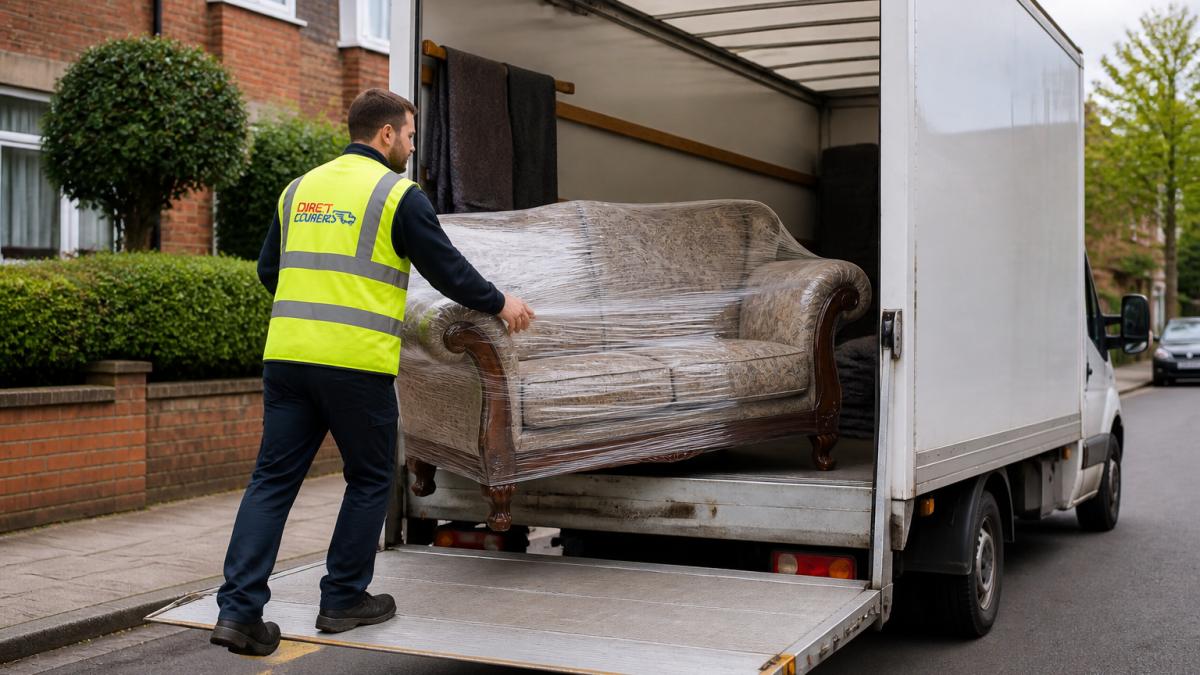
Secure handling starts before the vehicle moves. Straps, blankets, tail lifts and trained loading technique protect both item and driver, the difference between a sofa arriving intact and a claim.
Insurance is where buyers ask the sharpest questions. Standard courier cover is usually limited by weight or value per consignment, and full replacement value for an antique often needs declaring and paying for separately. Ask three things before booking:
- What is the cover limit per item, not per consignment?
- Is the item covered at its replacement value or a depreciated figure?
- What evidence is needed at the point of collection to support a claim?
Under UK law, carriers operate within a liability framework that sets default limits unless a higher value is declared, so the declaration is not a formality. Check the terms before the van arrives.
Real-Time Tracking and Improved Customer Satisfaction
Real-time tracking changes the customer conversation.
That visibility cuts friction on both sides: your team stops fielding "where is my order" messages, and the buyer stops wondering whether to stay in.
Courier software typically provides live location, delivery status and electronic proof of delivery.
- Live location updates shared directly with the customer
- Automatic notifications at collection, transit and delivery
- Electronic proof of delivery stored against the order
- Fewer inbound queries for your support team
If your clients keep asking for updates, that is a sign your current provider gives you nothing to share. Tracking access is the fix.
How to Choose a Reliable Courier Company
Choosing a reliable courier company comes down to five checks: insurance limits, tracking access, vehicle range, coverage area and how they handle a problem.
- Confirm the insurance limit per item and what is excluded
- Ask for a live tracking link on a test booking
- Check the fleet suits your loads, from small parcels to palletised goods
- Confirm nationwide coverage, not just local routes
- Ask what happens when a delivery is delayed or refused
- Request a quote based on your real shipping volume
- Read the terms on liability, claims deadlines and storage charges
A courier who answers the delay question with a process, rather than a promise, is the one to keep.
Courier Service vs Postal Service: Which Fits Your Needs?
The courier service vs postal service decision rests on three factors: item size, value and urgency. Standard post wins on cost for small, low-value, non-urgent items. A courier wins on everything else.
| Factor | Courier Service | Postal Service |
|---|---|---|
| Best for | Bulky, valuable, urgent items | Small, low-value letters and parcels |
| Handling | Direct, single vehicle | Consolidated, multi-depot |
| Tracking | Live, item-level | Usually status-based |
| Insurance | Declared value, per item | Low default limit |
| Delivery window | Agreed slot | Estimated |
| Accountability | Named contact | Reference number |
For a homeowner moving furniture, a seller shipping an antique, or an office relocating equipment, the courier column is the only realistic option. For a batch of paper documents, post is fine.
Reverse Logistics and Sustainability in Modern Courier Operations
Returns are where most delivery strategies quietly fall apart. A damaged or unwanted bulky item cannot go back through a letterbox network, and a poorly handled return costs more than the original delivery, which is why it deserves a proper look.
What reverse logistics actually involves
Reverse logistics is managing goods travelling backwards, from customer to seller, including collection, inspection and restocking. A professional courier handles it as a defined workflow rather than an afterthought:
- Return authorisation. The seller issues a return reference and confirms the item is eligible.
- Collection booking. The courier books a timed collection from the customer's address, often with a two-hour window rather than a full day.
- Collection and condition check. The driver records the item's condition at the door, photos and a signed note, before it moves.
- Transit and inspection. The item travels back to the seller or to a nominated inspection point.
- Restock, repair or disposal. The seller decides the outcome, and the courier either returns it to stock, holds it in short-term storage, or routes it for recycling.
Building this into your delivery plan from day one prevents the scramble when a return happens. The alternative, a customer booking a return through a consumer parcel network, is where bulky items get damaged, lost or abandoned.
How returns are priced
Returns are usually charged as a separate leg, not bundled into the outbound rate. Expect pricing to reflect:
- The same distance, vehicle and timing variables as an outbound job.
- A collection-only rate if the item is going back to your premises rather than to a third party.
- Storage charges if the item sits with the courier beyond an agreed free period.
- A condition-check fee if the courier is inspecting on your behalf.
For regular sellers, a negotiated returns rate is usually available and is worth asking for before you commit to a provider.
Sustainability: what actually reduces carbon
Sustainability ties directly into this: fewer failed deliveries, fuller vehicles and consolidated routes all cut mileage per parcel, lowering both cost and carbon footprint. One direct trip beats three redelivery attempts on every measure that matters.
The levers that genuinely move the needle are operational, not marketing:
- First-time delivery rate. Every avoided redelivery removes a whole journey.
- Vehicle fill. Consolidating multiple consignments onto one route reduces miles per parcel.
- Route planning. Software-planned routes cut idling and backtracking.
- Fleet choice. Smaller vehicles for smaller loads, and electric or low-emission vans for urban work, reduce emissions per drop.
- Reverse loads. A vehicle that would return empty can carry a return consignment instead, halving the mileage attributable to that item.
If a provider claims green credentials, ask what they measure and how they report it. A courier who can tell you their average drops per mile and redelivery rate is more credible than one who simply says they care about the environment.
Direct Couriers London Ltd handles exactly this combination: same-day and next-day delivery, a fully insured fleet from compact vans to tail-lift Luton vans, instant tracking and flexible storage for stock or belongings. That means a return, a short-term storage need and a nationwide delivery can sit with one provider instead of three.
Frequently Asked Questions
What are the primary advantages of using professional courier services over standard postal options?
Professional courier services offer faster delivery, real-time tracking, and secure handling for high-value or bulky items. Unlike standard post, couriers provide proof of delivery, insurance cover, and dedicated vehicles suited to heavy furniture or palletised goods. For time-sensitive shipments, same-day and next-day options reduce delays and customer friction, while direct communication with the courier gives you more control over collection and delivery.
How does professional courier tracking improve customer satisfaction?
Real-time tracking lets you and your customers see exactly where a shipment is, reducing anxious enquiries and missed deliveries. Automated notifications update recipients at key stages, which lowers first-attempt delivery failures and builds trust. For online sellers of bulky items, sharing a tracking link turns a nervous wait into a transparent experience, cutting customer service workload and improving repeat business.
Are professional courier services more cost-effective for small businesses?
Yes, for many small businesses. Courier services reduce overheads by handling transport, insurance, and storage, so you avoid buying vans or hiring drivers. They also cut losses from damaged goods and failed deliveries. Pricing depends on volume, distance, and urgency, so request a bespoke quote to compare against your current shipping spend. Many SMEs find that reliable delivery lowers total costs by preventing refunds and re-sends.
What security measures do professional courier services provide for high-value goods?
Reputable couriers use fully insured fleets, trained drivers, and secure loading practices. Vehicles range from compact vans to tail-lift Lutons, with goods wrapped and strapped for transit. Always confirm the level of insurance cover and whether it matches the replacement value of your items, and ask about tracking and proof of delivery.
Getting logistics right is less about the lowest quote and more about what happens when something goes wrong. Direct Couriers London Ltd offers fully insured nationwide delivery, a fleet sized from compact vans to tail-lift Luton vans, instant tracking and flexible short-term storage, so bulky and time-sensitive consignments stay accounted for from collection to doorstep. Contact us today to arrange a quote and keep your deliveries moving.