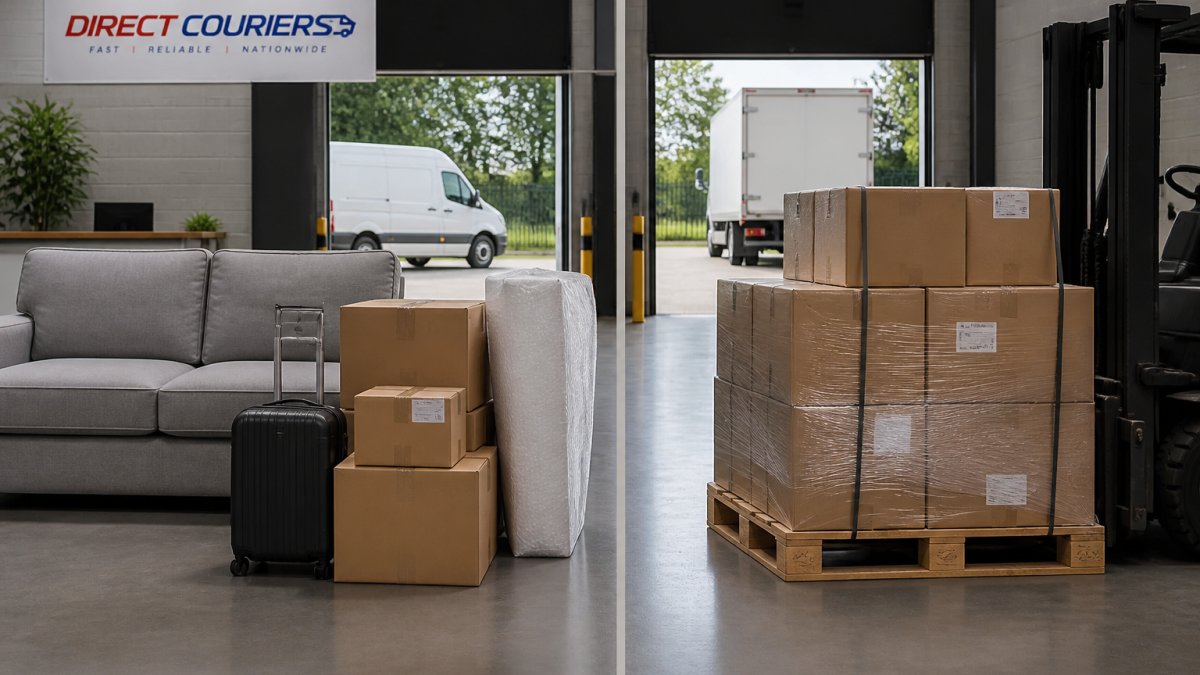
 comparison
Courier vs Freight for Heavy Goods: 2026 Comparison
Table of Contents
- Courier vs Freight for Heavy Goods: Key Differences at a Glance
- Weight Thresholds and Size Limits: When a Parcel Becomes a Pallet
- Palletised Shipping Rates: What Actually Drives the Cost
- Transit Times, Tracking and Door-to-Door Delivery Compared
- Tail-Lift Van Requirements for Heavy or Awkward Deliveries
- How to Secure Drawers for Furniture Transport
- Insurance, Liability and Packaging for Heavy Goods
- Conclusion
- Frequently Asked Questions
Last Updated: October 2, 2026
Courier vs Freight for Heavy Goods: Key Differences at a Glance
Choosing between courier vs freight for heavy goods comes down to one question: does your shipment travel as a parcel or as part of a palletised load? Courier services handle individual items with speed and door-to-door convenience. Freight forwarding moves consolidated shipping volumes on pallets, with slower transit times but a lower cost-per-unit. The table below summarises the split.
| Factor | Courier | Freight |
|---|---|---|
| Typical load | Single heavy item | Palletised cargo, bulk shipment |
| Weight focus | Item weight and dimensions | Total consignment volume |
| Speed | Same-day to next-day | 2-5 working days |
| Cost basis | Per shipment | Per pallet or per unit |
| Handling | Direct, door-to-door | Consolidated, terminal-based |
| Best for | Furniture, awkward items | Repeat bulk orders |
Courier wins on speed and flexibility. Freight wins on cost at volume. Most businesses need both.
Weight Thresholds and Size Limits: When a Parcel Becomes a Pallet
A parcel becomes a pallet when it stops moving as a single handled item. For most courier networks, that threshold sits around 50-70kg per piece or when an item needs a tail-lift to load. Above that, freight becomes the practical option.
Weight thresholds vary by carrier and by how the item is packed. A 90kg chest of drawers on castors is a courier job. The same weight as loose, unstackable components is a freight problem.
Size matters as much as weight. Couriers price on dimensional weight, so a bulky but light item can cost more than a dense one. Freight pricing works differently, based on pallet spaces and freight class rather than the shape of a single piece.
If your item is under the courier threshold, book a courier.
Palletised Shipping Rates: What Actually Drives the Cost
Palletised shipping rates are built from a small number of inputs, and understanding how each one moves the number is the difference between a quote that holds and one that gets surcharged after collection. In practice, four levers do almost all the work.
A worked example of the levers in motion
Take a consignment of six pallets of flat-pack furniture moving 300 miles. Priced as six separate pallets, you pay six pallet spaces plus six sets of handling. Consolidated onto four taller pallets, you pay four spaces, and the per-unit cost falls by roughly a third, not because the carrier discounted anything, but because you stopped paying for air.
What you can and cannot control
You control pallet count (through consolidation), packaging density (through how you build the pallet), and access (by confirming the delivery point in advance). You do not control the lane rate or the carrier's weight bands. The practical move is to give the carrier accurate dimensions, weights, and access details up front, an accurate quote on real numbers beats a cheap quote that gets surcharged.
Transit Times, Tracking and Door-to-Door Delivery Compared
Transit time is the clearest dividing line. A courier moves your item directly, often same-day or next-day. Freight moves it through a network of depots and consolidation points, which typically adds two to five working days.
Tail-Lift Van Requirements for Heavy or Awkward Deliveries
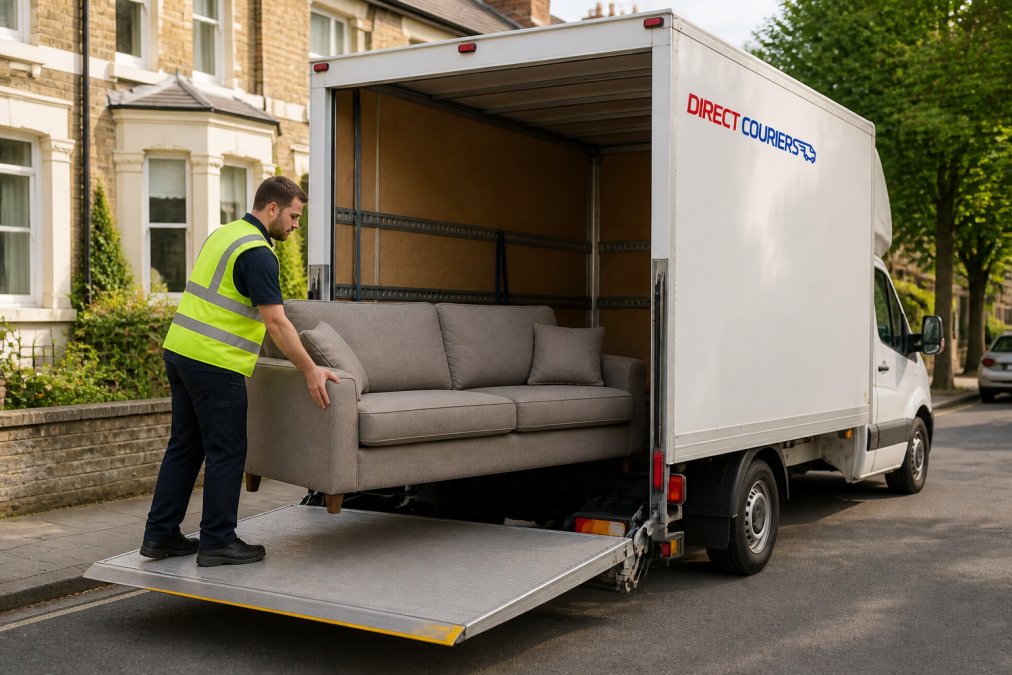
Tail-lift requirements come down to three checks:
- Weight per piece: anything a two-person team cannot safely lift needs mechanical assistance.
- Access at both ends: a tail-lift only helps if the van can park close enough to the door.
- Item stability: awkward, top-heavy or fragile pieces need a platform, not a ramp.
How to Secure Drawers for Furniture Transport
Knowing how to secure drawers for furniture transport prevents the single most common cause of transit damage: drawers sliding open mid-journey. Loose drawers shift weight, scratch frames, and can fall out entirely during loading.
Follow this sequence before the van arrives:
- Remove all contents and check each drawer runs freely.
- Push every drawer fully closed and confirm the runners are seated.
- Tape each drawer shut with low-tack or painter's tape across the front and frame.
- Wrap the whole unit in furniture blankets or bubble wrap, taped at the corners.
- Strap the unit upright against the van wall so it cannot tip or slide.
Insurance, Liability and Packaging for Heavy Goods
This is the section most guides skip, and it is where heavy goods shipments actually go wrong. Two mechanisms decide whether you are made whole after damage: how liability is calculated, and how the goods are packaged to survive mechanical handling. Both differ sharply between courier and freight.
How liability is calculated, and why it matters
Courier and freight liability are calculated on different bases, and the difference is not cosmetic.
- Courier (parcel) liability is typically a capped amount per consignment or per item, often set well below the true value of heavy or antique goods. Cover is usually included as standard, but the cap is the trap.
- Freight liability is commonly calculated by weight, a rate per kilogram, rather than by declared value. This is the critical asymmetry: a heavy, low-value item is well covered, while a light, high-value item (a small antique, a piece of specialist equipment) can be badly underinsured because its weight is low.
The documentation that underpins a claim
A consignment note or bill of lading is the contract of carriage and the basis of any claim. Without it, you have no proof of what was collected, in what condition, or on what terms. Before you ship anything valuable, check three things:
- The cover limit per item, not just per shipment.
- Whether high-value goods must be declared separately, and at what threshold.
- What evidence is required to claim, photographs at collection, a signed condition report, or both.
Packaging: palletising versus parcel boxing
Packaging requirements for heavy goods are stricter than for parcels, and the two methods are not interchangeable.
A practical palletising sequence:
- Build on a sound pallet, no broken boards, no protruding nails.
- Keep the load within the 1.2m x 1.0m footprint; overhang damages goods and gets refused.
- Stack heaviest items at the bottom, lightest on top, and keep the centre of gravity low.
- Use corner boards so shrink-wrap does not crush the edges.
- Shrink-wrap the load to the pallet itself, not just around the goods, so the load and pallet move as one unit.
- Label the pallet clearly with the delivery address and any handling instructions.
A pallet that is not shrink-wrapped to its base is the most common cause of freight damage. The load shifts on the pallet during linehaul, the wrap loosens, and the goods arrive unstable, often with the carrier declining the claim because the packaging did not meet the carriage requirement.
Matching the method to the risk
The decision rule is simple. If the item is hand-liftable and travelling alone, box it and confirm the courier's per-item cover limit. If it is palletised or travelling as part of a consolidated load, palletise it to the carrier's standard and declare its full value. Get both the packaging standard and the cover limit confirmed in writing before collection, that is the only point at which you still have leverage.
Conclusion
The courier versus freight decision is not about which is better. It is about matching the service to the load. Under the weight threshold, time-critical, or awkward: courier. Over it, repeat, or bulk: freight. Get that call wrong and you either overpay or wait days longer than you needed to.
Frequently Asked Questions
What is the difference between courier and freight services?
Couriers move individual parcels and heavy items door-to-door, usually with same-day or next-day options and a single driver. Freight forwarders consolidate multiple shipments onto pallets or into shared vehicles, which lowers the cost per unit for bulk loads but adds handling and longer transit times. In practice, courier vs freight comes down to weight, urgency and whether your goods can be palletised.
At what weight should I switch from courier to freight?
Many courier networks cap individual pieces around 30 to 50kg. For loads over roughly 100kg, or anything that needs a pallet, freight usually works out cheaper per unit. If the item is heavy but must arrive next day, a dedicated courier with a tail-lift van often beats a pallet network on speed.
How do I secure drawers for furniture transport?
Remove loose items and wrap the whole unit in bubble wrap or moving blankets. Tape drawers shut with low-tack tape, or pull them out and pack them separately if they slide freely. Strap the piece to the van wall or use furniture straps so it cannot shift. For antiques, use corner protectors and photograph the item before collection for insurance evidence.
What affects palletised shipping rates?
Rates depend on pallet dimensions and weight, the freight class, the collection and delivery postcodes, and whether the pallet is full or part of a consolidated load. Tail-lift access, waiting time and weekday versus weekend collection also change the price. Request a quote with exact dimensions and weight, because carriers price on the greater of actual or volumetric weight.
Are my heavy goods insured during courier transport?
Reputable couriers carry goods-in-transit insurance, but standard cover often caps payouts and excludes items like antiques or fragile glass unless declared. Ask for the cover level in writing before booking and check whether it is new-for-old or market value. For high-value pieces, arrange separate cover and photograph the item before collection so you have evidence if a claim is needed.