 how-to
Courier Services for Multiple Postcode Deliveries: 2026 Guide
Table of Contents
- Multi-Drop Courier Services: How Multiple Postcode Deliveries Work
- Route Optimisation for Couriers: Cutting Transit Time Across Postcodes
- Same-Day Multi-Stop Delivery: When It Makes Sense and What It Costs
- Pricing Factors for Multiple Postcode Deliveries: What Drives Your Quote
- Tracking and Delivery Confirmation Across Every Drop
- Packaging and Insurance: Protecting Goods on Multi-Stop Routes
- The Sustainability Impact of Multi-Drop Routing
- Frequently Asked Questions
Last Updated: September 13, 2026
Multi-Drop Courier Services: How Multiple Postcode Deliveries Work
Courier services for multiple postcode deliveries collect several consignments from one location and distribute them across different postcodes in a single run, usually on a shared or dedicated vehicle. At Direct Couriers London Ltd, we handle multi-drop routes daily, from single-pallet collections to full Luton van loads. The core principle is simple: one vehicle, many drops, sequenced so transit time and fuel use stay low. Multi-drop is not just "a courier with extra stops", it is closer to a small distribution network, and the planning decides whether the run is economical or wasteful.
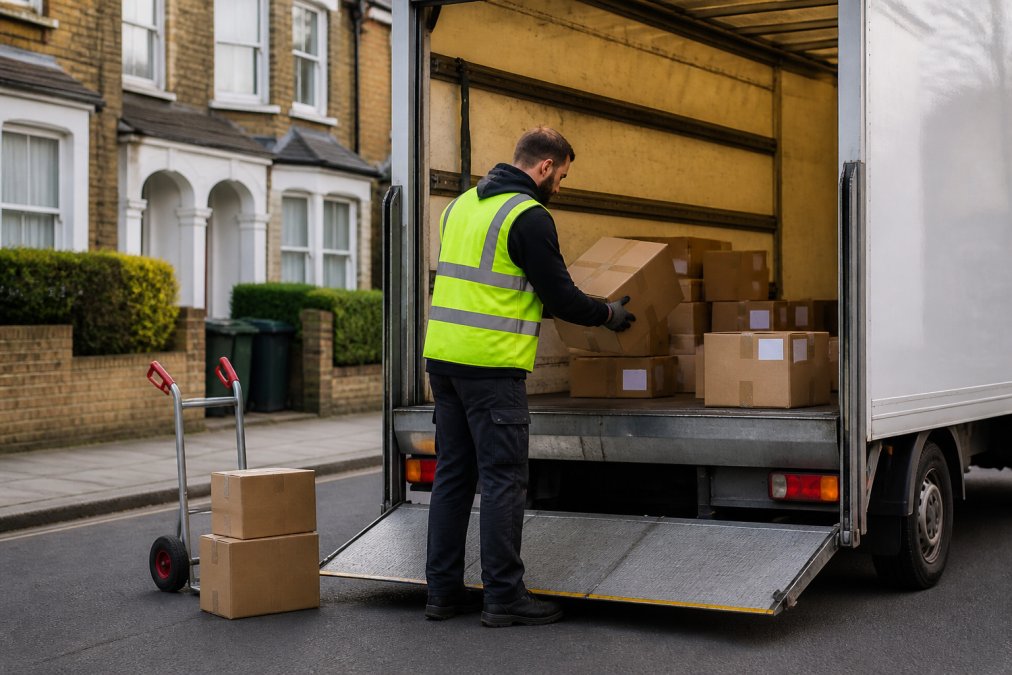
Multi-drop courier services differ from standard single-drop bookings in three ways: the vehicle carries mixed consignments, the route is sequenced by postcode, and the paperwork covers every stop. According to guidance on safe loading and vehicle weights from the Driver and Vehicle Standards Agency, load security and weight distribution are legal responsibilities, not optional extras, which matters more on a multi-stop run where the load shifts between drops.
Shared Routes vs Dedicated Vehicles: The Cost-Benefit Reality
The decision between shared and dedicated vehicles comes down to volume, timing, and control. A shared route means your goods travel alongside other consignments, so you pay only for the space you use; a dedicated vehicle means the van is yours for the day, with no third-party stops.
| Route type | Best for | Trade-off |
|---|---|---|
| Shared multi-drop | 5-20 small-to-medium drops | Less control over exact timing |
| Dedicated vehicle | High-value, bulky or timed drops | Higher day rate |
| Hybrid (part-shared) | Mixed loads across regions | Requires accurate volume estimates |
For a small e-commerce seller shipping bulky furniture, shared routing usually wins on cost. For an office relocation with fixed handover times, a dedicated vehicle is the only sensible option.
What Documentation You Need for Bulk Multi-Stop Deliveries
Every multi-stop run needs a consignment note per drop, a manifest listing all addresses in sequence, and proof-of-delivery capture at each stop. For higher-value goods, add a goods-in-transit insurance schedule that names the items and their declared value. Commercial vehicle operators must also comply with operator licensing rules from the Office of the Traffic Commissioner when running regular multi-drop work as part of a business.
Route Optimisation for Couriers: Cutting Transit Time Across Postcodes
Route optimisation for couriers is the process of sequencing stops by postcode, time window, and road conditions to minimise total distance and transit time. Done well, it turns a scattered list of addresses into a logical loop rather than a zigzag across the map.
The gains come from three levers: clustering drops by postcode district, ordering them to avoid backtracking, and matching vehicle size to load. A tail-lift Luton van that takes a full pallet saves a second trip when the load is heavy, even if the day rate looks higher upfront.
How API Integration Handles Multi-Postcode Logistics
API integration lets a booking system push multiple postcodes into a courier's dispatch platform in one call, returning a sequenced route and a single tracking reference per drop. For regular shippers, this removes manual address entry, reduces labelling errors, and generates bulk shipping labels automatically, so a warehouse team can process a day's orders without re-keying anything.
Same-Day Multi-Stop Delivery: When It Makes Sense and What It Costs
Same-day multi-stop delivery makes sense when the value of speed outweighs the premium: urgent parts, timed handovers, or customer promises you cannot break. It rarely makes sense for routine restocking that could go next-day, where a standard multi-drop network does the same job for a fraction of the cost.
The honest cost driver is not the number of parcels, it is the shape of the route. A same-day run is priced per route, built from five inputs: total mileage from collection through every drop and back to base, the number of drops, the vehicle class required, the tightness of the time windows, and access restrictions such as the London Congestion Charge or Ultra Low Emission Zone, loading-bay limits, or residential parking suspensions (Ultra Low Emission Zone). Two runs with identical drop counts can differ by hundreds of pounds if one is a tight loop around a single postcode district and the other a 90-mile sweep across three counties.
Dedicated Vehicle or Shared Network? A Cost-Benefit Framework
This decision moves your invoice the most. The rule of thumb: shared routing wins on cost per drop, dedicated vehicles win on control per drop, and the crossover point sits where your time windows or load profile stop fitting a shared schedule.
| Scenario | Shared multi-drop network | Dedicated vehicle |
|---|---|---|
| 5-20 small parcels, flexible timing | Almost always cheaper, you pay for space used | Day rate rarely justified |
| Bulky or palletised load, one postcode cluster | Possible but constrained by vehicle size | Usually cheaper than splitting across two shared runs |
| Fixed handover windows (e.g. office fit-out) | Poor fit, shared routes cannot guarantee slots | The only sensible option |
| High-value goods needing chain of custody | Risk of third-party handling | Preferred, with named driver and sealed load |
| Mixed load across regions | Workable if volume estimates are accurate | Hybrid part-shared can reduce cost |
A worked pattern: a small e-commerce seller shipping bulky flat-pack furniture to 12 addresses across two adjacent postcode districts will typically find a shared route cheaper, because the drops cluster and the load fits a single Luton van alongside other consignments. An office relocation with six fixed handover times across a single day will not, the shared network cannot hold those windows, so the dedicated day rate is the only workable structure, even though the mileage is lower.
When Same-Day Is the Wrong Answer
Same-day multi-stop work carries a premium that only pays off when a missed deadline has a real cost, a production line stopped, a contractual penalty, a customer relationship at risk. For routine replenishment, scheduled next-day multi-drop runs are cheaper and easier to plan, because the courier sequences your drops into an existing route rather than building a bespoke one. If your drops are predictable and repeatable, a standing next-day route will almost always beat ad-hoc same-day bookings on cost and reliability.
For current pricing on a specific route, request a quote against your actual address list rather than relying on generic per-parcel estimates, multi-drop pricing is route-based, not parcel-based.
Pricing Factors for Multiple Postcode Deliveries: What Drives Your Quote
Pricing for multiple postcode deliveries is driven by five variables: total distance, number of drops, parcel weight and dimensions, vehicle type required, and how tight the delivery windows are. Add access restrictions, such as congestion zone charges or loading bay limits, and the quote shifts again.
Because every run is different, fixed pricing only works once a route is defined. A reliable logistics partner will quote per route, not per parcel, and will tell you upfront what changes the price. If a quote looks unusually cheap, check what is excluded: waiting time, redelivery, and insurance are the usual omissions.
Tracking and Delivery Confirmation Across Every Drop
Real-time tracking and delivery confirmation should cover every stop, not just the first. A single tracking reference for the whole run is not enough when your customers each expect their own update. Look for per-drop tracking, photo proof of delivery, and a signature or PIN where the item is high value.
What Per-Drop Tracking Actually Means in Practice
On a properly configured multi-drop run, each consignment carries its own tracking reference, and the manifest ties those references back to a single route ID. That lets you answer two questions at once: 'where is the whole run right now?' and 'where is consignment seven?' A platform that only exposes the route ID forces you to phone the depot every time a customer asks about their parcel.
The data a business should expect per drop is consistent: a timestamped scan at collection, a timestamped scan at each delivery attempt, a geotagged photo or signature at handover, and a status flag (delivered, refused, no answer, safe place). If your logistics partner cannot export that per drop as a CSV or push it to your system, you will end up re-keying it manually, where most of the admin cost of multi-drop work sits.
Handling Failed Delivery Attempts on Multi-Stop Routes
Failed deliveries are the hidden cost of multi-drop work: a missed drop means a return trip, a redelivery fee, and a customer chasing updates. The fix is procedural and must be agreed before the run leaves the depot:
- Confirm the recipient's availability window before dispatch, not on the morning of delivery
- Capture a phone number for every drop, not just the first, the driver needs to be able to call ahead on a tight sequence
- Agree a safe-place or neighbour option in writing where the customer consents, so the driver has a fallback that does not break the route
- Photograph the drop location on arrival, whether the delivery succeeds or fails
- Log the failure immediately so the next attempt can be scheduled the same day rather than rolling into the next working day
- Flag any drop that fails twice for a depot hold, so the rest of the route is not delayed by repeated attempts
The operational principle is that a failed drop should never be resolved by the driver improvising. On a sequenced route, one improvised detour or extended wait pushes every subsequent drop back, and the knock-on effect is usually worse than the original failure. The protocol above keeps the route intact and moves the exception into a defined process.
Instant tracking access also helps you answer customer queries without chasing the courier. When a client asks where their furniture is, you should be able to answer in seconds, and when a drop has failed, you should already know before they do.
Packaging and Insurance: Protecting Goods on Multi-Stop Routes
Goods on a multi-stop route get handled more often than on a single-drop run, so packaging must survive repeated loading and unloading. Use rigid crates or double-walled cartons for fragile items, strap pallets, and label every parcel with its drop number as well as the address.
Insurance is the other half of protection. Confirm what the goods-in-transit cover includes, whether it is based on declared value or weight, and what the claims process requires. For antiques or high-value furniture, declare the full replacement value and keep photographs before collection.
The Sustainability Impact of Multi-Drop Routing
Multi-drop routing reduces the number of separate vehicle journeys needed to move the same goods, cutting total mileage and emissions compared with one-van-per-drop arrangements. The gains are largest when drops are clustered tightly by postcode and vehicles run full rather than half-empty.
Route optimisation and right-sized vehicles do most of the work: a well-sequenced run in a single Luton van will almost always beat three separate smaller vans covering the same addresses. For businesses reporting their delivery footprint, asking your logistics partner for mileage per run is a practical starting point.
Coordinating multiple postcode deliveries gets complicated fast when timing, weight, and paperwork all have to line up. Direct Couriers London Ltd handles this daily with a fully insured fleet running from compact vans to tail-lift Luton vans, same-day and next-day services, and instant tracking on every drop. We also offer flexible storage options for business stock or personal belongings when your goods need to wait. Contact us today to arrange your multi-drop run and get a quote built around your actual route.
Frequently Asked Questions
How do I send multiple parcels to different addresses?
Book a multi-drop courier service that consolidates your parcels into one route. You provide the collection address and each delivery postcode, and the courier plans an optimised sequence. Each parcel needs its own shipping label with a unique tracking number. For five or more drops, expect a fixed price per route rather than per-parcel pricing. Same-day multi-stop delivery is available if you book before the morning cut-off.
What are the benefits of using a dedicated multi-drop courier service?
A dedicated multi-drop courier keeps your goods in one vehicle from collection to final drop, reducing handling damage and transit time. You get one point of contact, one delivery confirmation per stop, and the option of same-day service across multiple postcodes. For bulky items like furniture or palletised goods, a dedicated vehicle avoids the sorting hubs that cause delays and breakages on shared networks. It also lets you set precise delivery windows for each recipient.
How does route optimisation impact the cost of multiple postcode deliveries?
Route optimisation for couriers reduces mileage, fuel use and driver hours, which lowers your quote. A well-planned multi-drop route can cut transit time by 20-30% compared with an ad-hoc sequence. Couriers pass some of that saving on through fixed pricing per route. If your drops are spread across distant postcodes, expect a higher quote because the vehicle is occupied longer. Grouping drops by region always reduces cost.
Can same-day courier services handle multiple postcode drops?
Yes, same-day multi-stop delivery is standard for dedicated vehicles. You book a collection time, list every delivery postcode, and the courier completes all drops that day. It suits urgent furniture deliveries, business relocations or stock replenishment across several retail sites. Pricing depends on the number of stops, total mileage and vehicle size. Book early in the day to secure a slot, and confirm any tail-lift or two-person requirements when you request a quote.