 how-to
What Does Temporary Warehouse Storage Cost?
Last Updated: November 7, 2026
Quick Summary
The cost of temporary warehouse storage depends on space, duration, site access and specification. Hire typically runs from around £8 to £25 per square metre per week, while delivery, installation and site preparation are quoted as separate line items.
- Hire rates fall as contracts lengthen, from £18 to £25 per square metre weekly for 1-4 weeks down to £8 to £13 beyond 12 months.
- Delivery and collection cost £350 to £1,200 each way for a rigid lorry load.
- Installation runs £15 to £45 per square metre, with dismantling often 60-80% of that.
- Site preparation adds £10 to £40 per square metre, higher where new hardstanding is needed.
- Racking can add £40 to £120 per square metre depending on beam levels and hire or purchase.
Table of Contents
- What Drives the Cost of Temporary Warehouse Storage
- Temporary Warehouse Cost: The Line Items in a Real Quote
- Warehouse Storage Cost per Square Metre: How to Read the Rate
- Temporary Warehouse Installation Costs and Site Preparation
- Temporary vs Permanent Warehouse Costs: Where the Money Goes
- Working Out Your Own Estimate Before You Request Quotes
- Reducing Your Temporary Warehouse Storage Bill Without Cutting Corners
- Getting a Storage Quote That Fits Your Project
- Frequently Asked Questions
What Drives the Cost of Temporary Warehouse Storage
The cost of temporary warehouse storage depends on four things: how much space you need, how long you need it, how easily a vehicle can reach the site, and how much specification you add. Get those four right and quotes become comparable. Get them wrong and you will pay for space you never use.
Palletised goods and bulky furniture are commonly moved in and out of temporary storage, and certain line items genuinely change a bill.
Temporary warehouse storage is not one product with one price. A 200 square metre clear-span unit on a flat concrete yard and a small climate-controlled bay inside a shared facility are different purchases.
Below, we break down each cost driver, show you how to read a rate per square metre, and give you a worked estimate.
Size, Duration and Site Access
Space is priced by floor area, so pin down usable square metres, not the building footprint.
Duration matters too. Short-term storage of a few weeks carries a higher weekly rate than a contract running several months, because mobilisation and demobilisation costs are spread over less time.
Site access is the quiet cost driver. If a 7.5-tonne vehicle cannot reach the door, or the ground cannot take a forklift, expect extra handling charges or a different structure altogether.
Specification Choices That Move the Price
A basic PVC-covered frame and a steel-framed building with insulated panels are not in the same price bracket. Materials drive the quote more than most buyers expect.
- PVC covers: quickest to install, lowest capital cost, suitable for dry goods and short durations
- Steel-framed structures: longer life, better weather resistance, higher installation cost
- Insulated panels: needed where temperature control matters, such as furniture, antiques or sensitive stock
- Fire retardancy: specified coverings and documented compliance add cost but may be required by your insurer
- UV resistance: relevant for anything stored through summer months
Ask for the specification in writing. A quote that says "temporary building" without naming the covering, frame and floor is not comparable.
Temporary Warehouse Cost: The Line Items in a Real Quote
Every credible quote breaks into the same groups. If a supplier gives you one lump sum, ask them to split it. Every quote is different, so pricing depends on site conditions, specification and dates.
| Line item | What it covers | What drives the figure | Indicative range |
|---|---|---|---|
| Hire or purchase | The structure itself | Floor area, duration, frame and covering | Hire from around £8 to £25 per square metre per week; purchase from around £250 to £600 per square metre |
| Delivery and collection | Transport to and from site | Distance, vehicle size, access restrictions | £350 to £1,200 each way for a rigid lorry load |
| Installation and dismantling | Labour, plant and supervision | Height, complexity, ground conditions | £15 to £45 per square metre installed, with dismantling often 60-80% of that |
| Site preparation | Groundworks, levelling, hardstanding | Existing surface, drainage, ballast or anchors | £10 to £40 per square metre, higher where new hardstanding is needed |
| Operating costs | Power, security, insurance, access equipment | Lighting, temperature control, alarm specification | £50 to £300 per week depending on services |
The exclusions list is where budgets break. Power supply, security lighting, pallet racking, fire extinguishers and contents insurance are frequently quoted separately.
A common mistake is comparing two quotes on the headline hire figure alone. The cheaper structure often carries the larger installation and site preparation bill. Ask every supplier to price the same brief and state the minimum contract period, then compare the total for your actual duration.
Watch out: if a quote excludes groundworks, site preparation can arrive as a variation after the contract starts, rarely priced at the original tender rate.
Warehouse Storage Cost per Square Metre: How to Read the Rate
Warehouse storage cost per square metre is the figure to use when comparing options, but only once you know what sits inside it. Two suppliers can quote the same rate and deliver very different amounts of usable space.
Check three things before comparing rates. First, confirm whether the area is internal floor space or external footprint, an angled roof or sloping site can cut usable area considerably. Second, ask whether the rate includes racking, since floor-level storage holds far fewer pallets than a racked layout. Third, check the minimum contract period: a low weekly rate tied to a long minimum term is not cheaper for a six-week project.
Rental pricing by duration
Hire rates generally fall as the contract lengthens because mobilisation and demobilisation costs are spread over more weeks. Pricing depends on quantity, dates and delivery, so request a quote for current figures.
| Duration | Typical weekly rate per square metre | Example: 200 square metre unit |
|---|---|---|
| 1-4 weeks | £18 to £25 | £3,600 to £5,000 per week |
| 1-3 months | £14 to £20 | £2,800 to £4,000 per week |
| 3-12 months | £10 to £16 | £2,000 to £3,200 per week |
| 12 months plus | £8 to £13 | £1,600 to £2,600 per week |
These rates assume the site is already level and drained and that the supplier can reach the door with a rigid lorry. Soft ground, restricted access or a need for ballast and anchors will add to the installation line rather than the weekly rate.
A worked estimate
Pricing for any specific project depends on site, specification and dates, so request a quote from Direct Couriers London Ltd to see the figures for your own brief.
Comparing alternatives on the same time horizon
For a short requirement, renting existing warehouse space often carries a minimum lease term far longer than the need.
Rate per square metre works best as a sanity check, not a decision tool. Build your estimate around pallets or cubic metres of goods instead, then use the per-metre rate to confirm the space is priced sensibly.
Watch out: a rate quoted per square foot rather than per square metre is a common source of confusion, so convert every quote to the same unit before you compare.
Temporary Warehouse Installation Costs and Site Preparation
Installation is the line item buyers underestimate most often. A temporary structure needs level ground, adequate drainage and enough clearance for the delivery vehicle and lifting equipment.
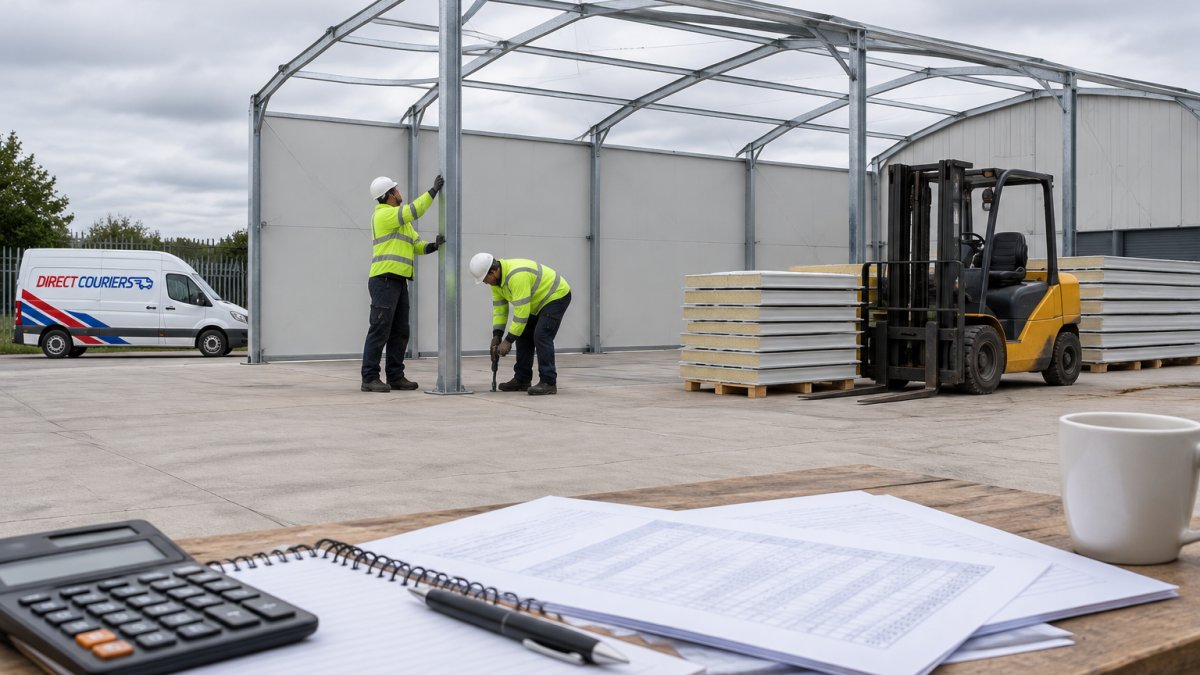
Site preparation typically covers:
- Levelling and compacting the ground
- Laying or improving hardstanding where the surface is soft
- Confirming drainage so water does not pool under the floor
- Checking overhead clearance for delivery and lifting equipment
- Arranging power if lighting or temperature control is needed
Watch out: if the ground is soft or uneven, the structure may need ballast or ground anchors, and that cost usually lands after the quote is signed.
Planning permission and building regulations are separate questions. Permanent structures generally need permission; temporary buildings often fall under permitted development, but the rules depend on the site, the duration and the local planning authority.
Temporary vs Permanent Warehouse Costs: Where the Money Goes
The comparison is not close, but it is not a straight saving either. A permanent warehouse carries land acquisition, design fees, planning, construction, and a long payback period.
For a defined project, that difference is decisive.
The break-even point sits where your total hire and installation spend approaches the capital cost of a permanent structure. Work that out before you assume temporary is cheaper.
Temporary warehouse storage buys flexibility, and you pay a premium for it. For a refurbishment, a seasonal peak or a stock build-up, the premium is small against the alternative.
Working Out Your Own Estimate Before You Request Quotes
Build your estimate in this order and you will get comparable quotes back.
- Count your storage requirement in pallets, cubic metres or square metres of floor space
- Decide the duration in weeks, and note whether it could extend
- Record the site: surface type, access width, overhead clearance, distance from the road
- Choose a specification level: basic cover, steel frame, or insulated and temperature controlled
- List what you need inside: racking, shelving, power, lighting, security
- Note what you will handle yourself and what needs labour
- Add a contingency for site preparation once the ground has been surveyed
If you are weighing outsourcing against holding stock yourself, our guide on whether 3PL fulfillment is worth it for small retailers sets out the trade-offs. For a broader view of the options before you price anything, read what commercial storage is and how to choose the right service.
Reducing Your Temporary Warehouse Storage Bill Without Cutting Corners
Cost comes out of a quote in three places: space, time and specification. Trim the wrong one and you create a bigger bill later.
Use height before you use floor area. Racking a smaller footprint is usually cheaper than renting a larger flat space.
Book the shortest honest duration. Extending a hire mid-contract often costs more than booking the longer term up front, so estimate realistically.
Separate what needs protection from what does not.
Consolidate deliveries. Every separate vehicle movement into and out of the building is a cost, and grouping collections reduces handling.
Keep an accurate inventory. Our guide to secure storage for ecommerce stock covers how to keep stock moving so you are not paying for dead space.
Getting a Storage Quote That Fits Your Project
The best quote is the one you can compare.
Ask each supplier to confirm what is included and what is not, and to state the minimum contract period.
Direct Couriers London Ltd runs a fully insured fleet from compact vans to tail-lift Luton vans, with same-day and next-day delivery and instant tracking.
Flexible storage options for business stock or personal belongings are among the services Direct Couriers London Ltd provides. You can view our storage service and request a quote once you have your brief together.
For a practical comparison of short-term options, our guide to short-term business storage solutions walks through the choices in more detail.
The real risk in this purchase is not paying too much per square metre.
Frequently Asked Questions
How is temporary warehouse storage priced?
Most suppliers quote on three variables: floor area in square metres, the length of the hire or purchase term, and the specification of the structure. A basic PVC-covered frame on a level concrete pad sits at the cheaper end; steel-framed buildings with insulation, temperature control and fire retardancy cost more. Delivery, installation, dismantling and site preparation are usually quoted as separate line items, so ask for an itemised breakdown rather than a single figure. Pricing depends on your site and dates, so request a quote for an accurate number.
Is temporary warehouse storage cheaper than renting a permanent warehouse?
It usually is for short projects. A permanent lease brings rent, business rates, service charges and often a multi-year commitment, plus fit-out costs. A temporary structure carries a one-off supply or hire charge, installation and dismantling, and no long lease. Once the project runs long enough that cumulative hire charges approach the cost of a lease plus fit-out, the permanent option can win. Compare the total cost over your actual project duration, not the headline monthly figure.
Do temporary warehouse storage costs include installation and removal?
Not always. Some suppliers bundle delivery, erection and dismantling into the headline price; others quote the structure alone and add installation as a separate charge. Always confirm in writing whether the quote covers groundworks, anchoring, electrical connections, dismantling and collection. A quote that looks lower can end up costing more once these items are added, so ask each supplier to list what is included and what is excluded.
How can I reduce temporary warehouse storage costs?
Plan the footprint properly: over-ordering floor area is the most common overspend. Book a level, well-drained site so you avoid groundworks. Choose a shorter hire term where possible and confirm the rate for extension. Share access routes and delivery windows to cut installation time. If you need stock moved in and out, consider arranging storage and transport together so you are not paying two suppliers for the same handling.