 ultimate-guide
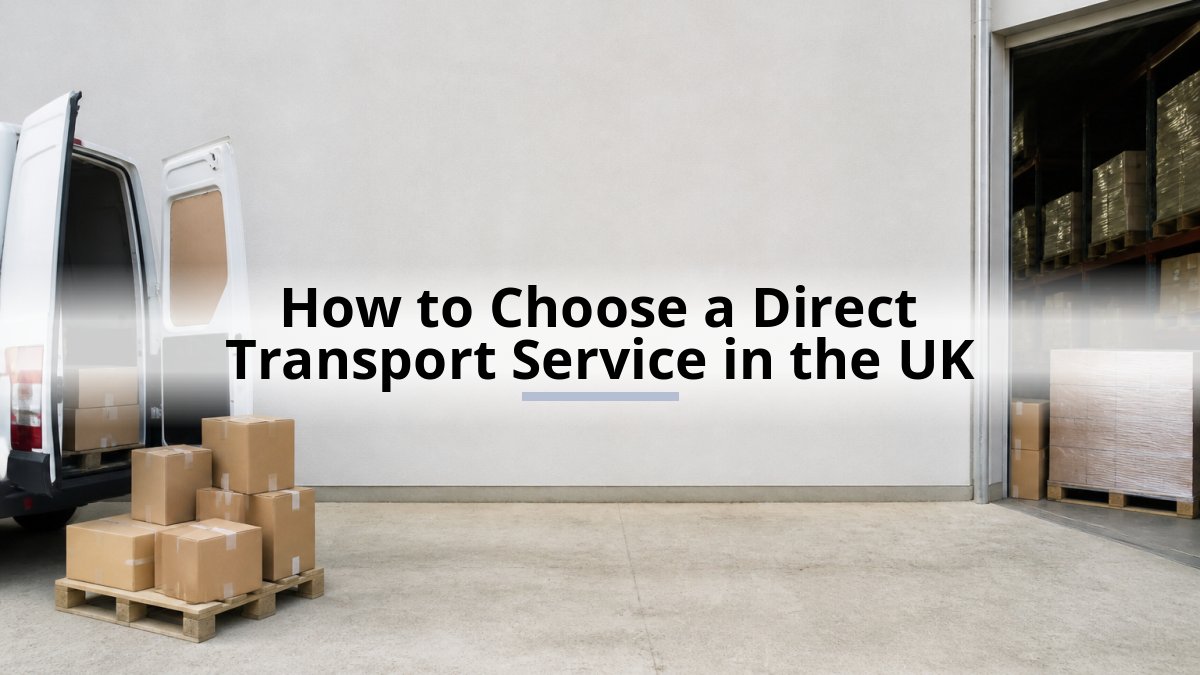
How to Choose a Direct Transport Service in the UK
Quick Summary
Direct transport is a service where one vehicle collects your goods and delivers them straight to the destination, with no stops for other customers' consignments. Choose a provider by checking the vehicle specification, insurance limits, tracking, proof of delivery and written inclusions. Compare quotes on total cost for your actual job.
- Direct transport uses a dedicated vehicle, so goods have fewer handling points.
- Confirm the vehicle's payload and tail-lift capacity in writing before booking.
- Standard cover is often well below the value of furniture, antiques or specialist equipment.
- Ask whether proof of delivery is a signature, a photograph or both.
- Get the cancellation policy and waiting-time charges in writing.
Table of Contents
- Last Updated: October 26, 2026
- What Direct Transport Means and How It Works
- Direct Transport Versus a Standard Courier Service
- When a Same-Day Courier Service Makes Sense
- Handling Large, Heavy and Palletised Goods
- Tracking, Delivery Proof and Insurance
- How to Choose a Reliable Direct Transport Provider
- Booking Your Next Direct Transport Job
- Frequently Asked Questions
Last Updated: October 26, 2026
Last Updated: October 26, 2026
What Direct Transport Means and How It Works
Direct transport is a service where a single vehicle collects your goods and delivers them straight to the destination, without stopping to pick up or drop off other customers' consignments along the way. A direct run is a dedicated journey, so timings are easier to predict and goods travel with fewer handling points.
Direct transport is not the same as a fast delivery. A provider can offer same-day service while still consolidating loads, and a direct run can take longer if the route is long. The distinction is about how the journey is organised, not how quickly it is promised.
In practice, a direct booking usually works like this:
- You confirm collection and delivery addresses, dates and access details.
- The vehicle is allocated to your job alone.
- The driver collects, travels the route and delivers, with your goods on board from start to finish.
For bulky furniture, palletised stock or heavy equipment, this matters because each extra handling stage adds risk of damage and delay.
Direct Transport Versus a Standard Courier Service
A standard courier service suits parcels and small items that fit through a letterbox or in a single box. Consignments are typically sorted through a depot network, so one job may share a van with several others. That model keeps costs down for small loads but can mean more handling and less control over timing.
Direct transport suits larger or more sensitive goods, such as:
- Furniture and antiques that need careful handling
- Palletised goods that cannot be split up
- Stock moving between a warehouse and several delivery points on a fixed schedule
Pricing depends on load size, distance, access and timing, so ask for a written quote that states exactly what is included.
When a Same-Day Courier Service Makes Sense
Same-day courier service is the right choice when goods must arrive within hours, for example a replacement part for a stopped production line or a customer order promised for the afternoon. The value lies in the time saved, not in the transport method itself, so check whether a direct booking can meet the same deadline.
Same-day work carries specific risks. Collection windows are tighter, so a delay at the start cascades through the whole day. Ask your provider how they handle cancellations and what happens if a vehicle is unavailable.
If the job is bigger than a courier run, such as a full household move, a removals service may be a better fit than a single same-day van.
Handling Large, Heavy and Palletised Goods
Large and heavy goods need the right vehicle before they need the right driver. A tail-lift Luton van is one vehicle option to consider for palletised loads and heavy items. Before booking, confirm the weight, dimensions and whether the destination has suitable access.
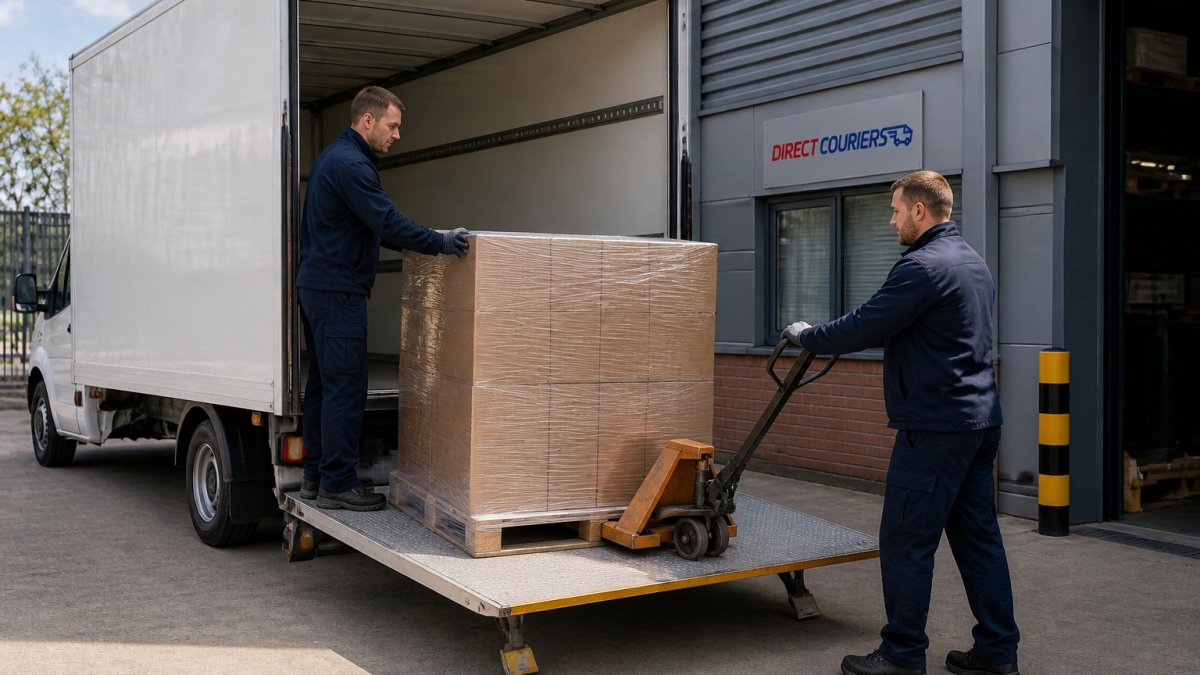
For palletised freight, check the pallet size, stacking height and whether the load is wrapped and secured. Our fleet includes compact vans through to tail-lift Luton vans, so the vehicle can be matched to the consignment. If you need to move palletised freight, you can book a pallet delivery and specify the dimensions at the time of enquiry.
Tracking, Delivery Proof and Insurance
That does not mean every provider offers the same level of tracking.
Tracking on a direct job Ask what updates you receive and when. A typical direct service provides:
- Booking confirmation with the allocated vehicle type and collection window
- A collection notification once goods are loaded
- An in-transit update or live vehicle location, depending on the provider's system
- A delivery notification with proof of delivery attached
Live tracking is not universal. Some providers send driver contact details instead, which works well for time-critical jobs where you need to speak to the person holding your goods. Confirm which model applies before you book, and check whether updates go to you, the consignee or both.
Proof of delivery Proof of delivery protects both sides. Ask whether it takes the form of a signature, a photograph of the goods in place, or both, and whether it is captured electronically and sent automatically. For high-value items, request a signed note that records the condition of the goods at delivery, not just the time. Keep the collection paperwork and the delivery record together, if a damage claim arises, the pair is the evidence base.
Goods-in-transit insurance explained Goods-in-transit cover is a specific policy that protects goods while they are in the carrier's custody. It is not the same as the carrier's own motor insurance, and it is not automatically included at full value. When you review a quote, check:
- Cover limit: usually stated per vehicle or per consignment. A limit of a few thousand pounds may be adequate for palletised stock but not for antiques or specialist equipment.
- Basis of settlement: new-for-old replaces the item; indemnity pays the market value at the time of loss, which may be lower.
- Excess: the amount deducted from any claim. A low premium can hide a high excess.
- Exclusions: common exclusions include inadequate packaging, prohibited goods, and items left unattended. Ask for the exclusion list in writing.
- Declaration requirements: high-value items often need to be declared before collection. Undeclared goods may be covered only up to a basic limit.
Claims process Ask how a claim is made, what evidence is required and how long it takes. A workable process usually requires:
- Notification within a stated window (often a few days of delivery)
- Photographs of the damage and the packaging
- The signed delivery note and collection record
- A repair quote or replacement valuation
Get this in writing before booking. A provider that cannot explain its claims process clearly is a risk, regardless of price.
Packaging and loading responsibilities Insurance often depends on packaging being fit for transport. Confirm who is responsible for packing, who loads and unloads, and whether the driver is expected to move goods beyond the kerb. If you pack the goods yourself, ask what standard the insurer expects, double-walled cartons, pallet wrapping and edge protection are common requirements. Damage claims frequently fail on packaging grounds, so clarify this at the quote stage.
How to Choose a Reliable Direct Transport Provider
Most providers look similar on a quote. The difference shows up in what the quote excludes, how the vehicle is specified and what happens when something goes wrong. Use the checklist below as a comparison framework rather than a tick-box exercise, and score each provider against the same criteria.
1. Vehicle and load suitability Confirm the exact vehicle type, internal dimensions, payload limit and tail-lift capacity in writing. A tail-lift Luton typically handles pallets up to around 1,000 kg, but the safe working load varies by vehicle, ask for the figure rather than assuming. If your load is at or near the limit, ask whether the provider will send a larger vehicle or split the run.
2. Coverage and service area Ask whether your collection and delivery postcodes fall inside the provider's core area or attract an out-of-area surcharge. A provider that runs nationally may still consolidate loads outside its home region, which undermines the point of a direct booking. Confirm that the vehicle allocated to your job will travel directly, not via a depot.
3. Insurance and liability This is where quotes diverge most. Ask for:
- The goods-in-transit cover limit per consignment (often stated per vehicle, not per item)
- Whether cover is on a new-for-old or indemnity basis
- The excess you would pay on a claim
- Whether high-value items need to be declared before collection
- The claims window and the evidence required (photos, signed delivery note, repair quote)
Standard cover is frequently capped well below the value of furniture, antiques or specialist equipment. If your goods exceed the limit, ask for extended cover in writing before booking.
4. Tracking and proof of delivery Ask what visibility you get at each stage: collection confirmation, in-transit updates and delivery. Confirm whether proof of delivery is a signature, a photograph or both, and whether it is sent to you automatically or only on request. For business sellers answering customer queries, automatic delivery confirmation is worth more than a tracking link alone.
5. Cancellations, delays and waiting time Get the cancellation policy in writing, including the notice period and any fee. Ask how waiting time is charged, per hour, per half-hour, or in fixed blocks, and what triggers it (late access, missing paperwork, a consignee not ready). Waiting-time charges are a common source of invoice disputes.
6. Written quote and inclusions Compare quotes on total cost for your actual job, not on headline price.
7. Scale and fit Tell the provider your monthly volume and typical load profile at the outset. A provider set up for occasional single-pallet jobs may not offer competitive rates for regular multi-drop work, and a large operator may not prioritise a one-off furniture move. An honest answer about fit saves time later.
8. Compliance and paperwork Ask for confirmation of goods-in-transit insurance, vehicle roadworthiness and driver licensing. For business customers, check whether the provider can supply a waste transfer note where applicable, and whether they hold the correct operator licence for the vehicle weight. These are basic checks that separate established operators from informal arrangements.
Score each provider against these eight points and keep the written responses. The provider that answers all eight clearly is usually the safer choice, even if the headline price is slightly higher.
Compare providers against the same eight checks, using these points from the article.
| Check | What to confirm | Why it matters |
|---|---|---|
| Vehicle and load | Vehicle type, dimensions, payload, tail-lift capacity | Load must fit the vehicle within its limit |
| Coverage | Core area or out-of-area surcharge | Shows whether the run is truly direct |
| Insurance | Cover limit, settlement basis, excess, exclusions | Standard cover is often well below high-value goods |
| Tracking and proof | Collection, in-transit and delivery updates | Signed or photographed proof protects both sides |
| Cancellations and waiting | Notice period, fees, waiting-time charges | Waiting charges are a common invoice dispute |
| Written quote | Total cost for your actual job | Makes quotes like-for-like |
| Scale and fit | Monthly volume and load profile | Matches the provider to your job type |
| Compliance | Insurance, roadworthiness, driver licensing, operator licence | Separates established operators from informal arrangements |
Booking Your Next Direct Transport Job
To book smoothly, prepare the details before you call or submit an enquiry:
- Collection and delivery addresses, including postcodes and access restrictions
- Weight, dimensions and number of items or pallets
- Preferred date and time window
- Any handling requirements, such as fragile or high-value goods
- Whether you need storage at either end
If goods must be held between legs, the storage service may be relevant. Once your booking is confirmed, keep your tracking reference to hand so you can answer customer queries without delay.
Direct Couriers London Ltd can be contacted through its website to request a quote for your job.
Frequently Asked Questions
What does direct transport mean?
Direct transport means a vehicle collects goods from one point and delivers them to another. Pricing depends on the job, so request a quote from Direct Couriers London Ltd for current costs.
How does direct transport differ from a standard courier service?
Ask any provider whether your goods will be transferred between vehicles, and confirm the collection and delivery windows before booking.
Can direct transport handle large or palletised goods?
Direct Couriers London Ltd's fleet ranges from compact vans to tail-lift Luton vans, and its services include delivery of heavy items and palletised goods. Measure the largest item, check its weight and confirm access at both collection and delivery addresses. Tell the provider about any stairs, narrow entrances or restricted parking.
How can I track a direct transport delivery?
Direct Couriers London Ltd provides instant access to tracking information. Ask the provider what information is available through its tracking service.