 how-to
How to Ship Heavy Furniture Safely: A 2026 Guide
Table of Contents
- Step 1: Choose the Right Shipping Method for Your Furniture
- Step 2: Gather Materials and Prepare for Packing
- Step 3: How to Secure Drawers for Furniture Transport
- Step 4: How to Palletise Furniture for Shipping
- Step 5: Understanding Shipping Costs and Carrier Restrictions
- Step 6: Choosing Courier Services for Heavy Items UK
- Common Mistakes to Avoid When You Ship Heavy Furniture
- DIY vs. Professional Crating and Sustainability
- Conclusion: Ensuring a Safe Delivery
- Frequently Asked Questions
Last Updated: September 12, 2026
Step 1: Choose the Right Shipping Method for Your Furniture
Getting this decision wrong is the most expensive mistake in the process. If you want to know how to ship heavy furniture safely, the method you choose determines everything that follows: how you pack, what you pay, and how much risk you carry.
LTL freight is the transport of palletised goods that share truck space with other shipments, while a courier service handles individual items door-to-door. For a single sofa, a courier is almost always simpler. For multiple pieces or anything over roughly 100kg, LTL freight usually works out cheaper per item.
LTL Freight vs. Courier Service: What's the Difference?
LTL freight, or less-than-truckload, suits bulky loads that fill a pallet or more. Your goods travel on a shared vehicle, which keeps costs down but adds handling stages and transit time.
A dedicated courier service collects from your door and delivers directly, with far less handling. For heavy or fragile items, fewer touchpoints means less transit damage.
Step 2: Gather Materials and Prepare for Packing
Correct materials stop most damage before it happens. A common mistake is using thin supermarket boxes and single-layer tape, which fail under load.
You will need:
- Double-wall corrugated cardboard for edges and base layers
- Bubble wrap for finished surfaces and fragile items
- Moving blankets for large flat panels
- Shrink wrap to bind everything together
- Heavy-duty tape, corner guards, and a hardware bag
Wrap each piece in bubble wrap first, then add cardboard over corners and edges. Tape every seam twice. This layering is what gives packaging integrity when a load shifts.
Step 3: How to Secure Drawers for Furniture Transport
Drawers are the single most common source of in-transit damage. Loose drawers slide out, crack rails, and scratch finished surfaces.
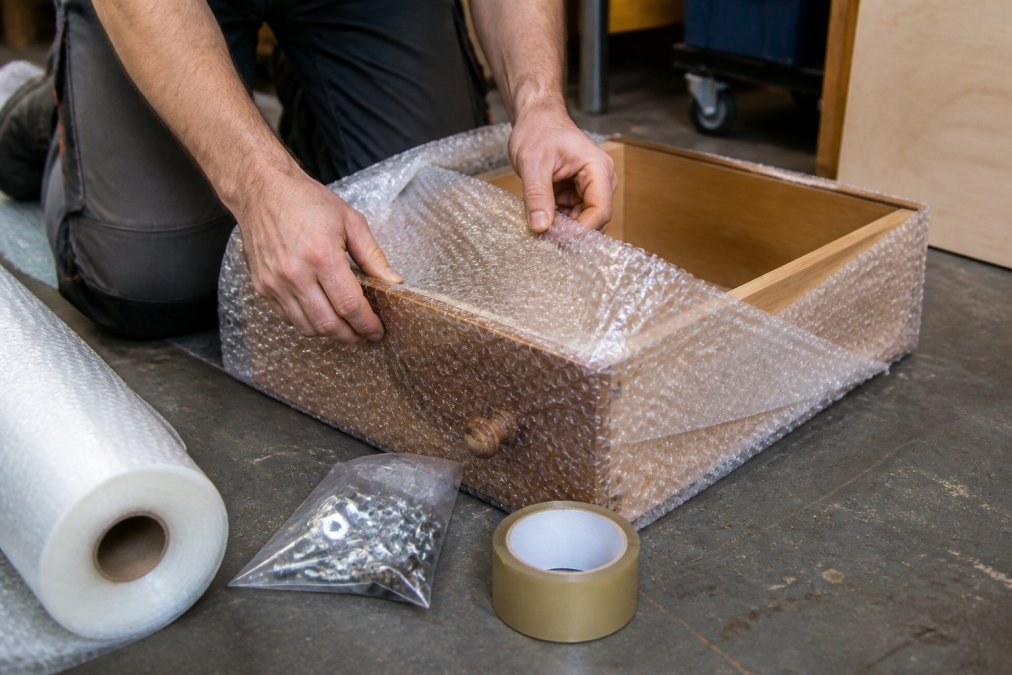
Remove every drawer if the piece allows it, then wrap each one separately. If removal is impractical, secure them shut with shrink wrap around the whole carcass, never tape directly onto a finished surface.
Securing Doors, Panels, and Moving Parts
Doors, flaps, and folding panels need the same treatment. Tape hinges in place, then pad the joints with bubble wrap so movement is absorbed rather than transferred.
Step 4: How to Palletise Furniture for Shipping
Palletising turns an awkward item into a stable, machine-liftable unit. Centre the weight over the pallet, keep the heaviest pieces at the bottom, and never let anything overhang the edges.
Protecting Finished Surfaces and Load Stability
Finished surfaces scratch against almost anything, including other furniture. Corner guards and moving blankets handle the edges, where impact damage concentrates.
For load stability, strap the item down to the pallet and wrap the base tightly. A pallet that shifts in transit is a claim waiting to happen.
Step 5: Understanding Shipping Costs and Carrier Restrictions
Pricing depends on dimensions, weight, distance, and service level, so there is no single figure to quote. Request an itemised shipping quote rather than a headline number, and ask the carrier to show the chargeable weight separately from the actual weight.
How Dimensional Weight Is Calculated
Parcel carriers bill on whichever is greater: actual weight or volumetric (dimensional) weight. The standard volumetric formula used by most parcel networks is:
Length × Width × Height (cm) ÷ 5,000 = volumetric weight in kg
A wardrobe measuring 180 × 60 × 60 cm has a volumetric weight of 129.6 kg even if it weighs only 45 kg. That is the number you will be billed on, which is why a bulky-but-light item can cost more to send than a dense chest of drawers of the same physical size.
Weight Thresholds: Where Parcel Networks Stop and Freight Takes Over
Most parcel networks in the UK cap individual items at around 30 kg for standard collection, with some accepting up to roughly 50 kg on premium services (ofcom.org.uk). Above that, the item generally has to move as freight. The practical bands look like this:
| Chargeable weight | Typical routing | Handling |
|---|---|---|
| Under 30 kg | Standard parcel network | Manual sort, conveyor belts |
| 30-50 kg | Premium parcel or small freight | Two-person lift, tail-lift may be needed |
| 50-500 kg | LTL / palletised freight | Forklift or pallet truck, pallet required |
| 500 kg+ | Full load or dedicated vehicle | Crane or specialist lifting equipment |
These are industry norms rather than fixed rules, each carrier publishes its own limits, and they change. Always confirm the current threshold with the specific provider before booking.
Other Restrictions That Catch People Out
- Maximum single-dimension length. Many parcel networks refuse items over roughly 1.5-2.5 m on the longest side, regardless of weight.
- Girth limits. Length plus girth (2 × width + 2 × height) is capped on parcel services; a long, thin item like a dining table can breach this even when it is light.
- Tail-lift access. A palletised load over roughly 250 kg usually needs a tail-lift vehicle at both collection and delivery (hse.gov.uk). If either address lacks a loading bay or forklift, book the tail-lift option explicitly.
- Residential vs. commercial. Many freight rates assume a loading dock. Residential collections and deliveries often carry a surcharge and a longer collection window.
How to Get an Accurate Quote
- Weigh the item on a bathroom scale or luggage scale, or estimate from the material (solid oak is roughly 700-900 kg per cubic metre; MDF and particleboard are lighter).
- Measure the packed dimensions, not the bare item.
- Calculate volumetric weight using the formula above and use whichever figure is higher.
- State clearly whether the item is palletised, whether a tail-lift is needed at both ends, and whether either address is residential.
- Ask for the quote in writing with the chargeable weight shown, so you can challenge a re-weigh at the depot.
Step 6: Choosing Courier Services for Heavy Items UK
The right provider turns a stressful move into a predictable one. Look for a fully insured service, tail-lift vehicles for heavy loads, and tracking you can access instantly.
Our fleet ranges from compact vans to tail-lift Luton vans, so heavy furniture and palletised goods are handled with the right vehicle from the start. Every delivery is fully insured, and same-day or next-day options cover urgent shipments.
What to Look for in a Courier and How Insurance Works
Ask three questions before booking: what does the insurance actually cover, is there a bill of lading or consignment note, and how do I track the shipment?
For high-value antiques, check whether cover is based on replacement cost or a weight-based limit. For international customs, confirm who handles the paperwork.
Common Mistakes to Avoid When You Ship Heavy Furniture
Most failures trace back to a handful of avoidable errors:
| Mistake | Fix | Impact |
|---|---|---|
| Thin single-wall boxes | Use double-wall corrugated | Fewer crush and puncture claims |
| Loose drawers and doors | Wrap shut or remove | No cracked rails or scratches |
| Overhanging pallet loads | Keep weight centred | Stable load, no tipping |
| Skipping insurance | Insure at replacement value | Full cover if damage occurs |
DIY vs. Professional Crating and Sustainability
Some pieces justify a custom crate: antiques, glass-fronted cabinets, and anything irreplaceable. A professionally built crate costs more but survives rough handling that a wrapped item will not (bsigroup.com).
On the sustainability side, reusable moving blankets and recyclable cardboard reduce waste without compromising protection. If you ship regularly, reusable crates pay for themselves over time.
Conclusion: Ensuring a Safe Delivery
Heavy furniture shipping rewards preparation over speed. Choose the right method, secure every moving part, and palletise anything bulky before it leaves your door.
When the load is genuinely heavy or high-value, professional handling removes the risk. Direct Couriers London Ltd offers fully insured delivery, a fleet built for heavy and palletised goods, instant tracking, and flexible storage for stock or belongings during a move or renovation. Contact us today for a quote.
Frequently Asked Questions
What is the cheapest way to ship large, heavy items within the UK?
The most cost-effective method is often LTL (less-than-truckload) freight, especially if you can palletise the item yourself. This is typically cheaper than a dedicated courier service for a single item. Getting quotes from several providers is key. Pricing depends on the item's dimensions, weight, and the delivery postcodes. For a precise cost, you should request a quote from a courier service based on your specific requirements.
How do I prepare heavy furniture for courier collection?
Start by disassembling items where possible and bagging all hardware. Wrap the furniture in moving blankets or bubble wrap, then add a layer of corrugated cardboard for protection. Secure drawers and doors with heavy-duty tape. If the item is very heavy, secure it to a pallet. Clear labeling with 'Fragile' and 'This Way Up' is essential. Finally, confirm the collection details and any weight-based carrier restrictions with your chosen courier beforehand.
What materials are required to pack heavy furniture for transit?
You will need several key materials for safe transit. These include moving blankets or furniture pads for surface protection, bubble wrap for cushioning, and sturdy corrugated cardboard for outer protection. Heavy-duty packing tape is essential for sealing boxes and securing wrap. For securing drawers and doors, use strong tape. If palletising, you will also need a wooden pallet, shrink wrap, and corner guards to protect edges and maintain load stability.
Do I need specialist insurance for shipping heavy furniture?
Yes, you should always check the insurance coverage offered by your courier. Standard liability coverage may be insufficient for high-value or antique items. Specialist shipping insurance, often called 'goods in transit' insurance, provides more comprehensive cover against damage or loss. Before booking, ask the courier for details on their claims process, what is covered, and the maximum payout. For valuable items, it is wise to arrange separate, dedicated insurance.