 how-to
Ensure Furniture Delivery on Time: A 2026 Guide
Table of Contents
- Why Furniture Deliveries Get Delayed (and How to Prevent It)
- Your Furniture Delivery Preparation Checklist
- Measuring Access Points: Doorways, Stairs, and Lifts
- How Same Day Furniture Delivery Services Work
- Managing Delivery Expectations for High-Value Items
- Tracking Your Order and Communicating with Your Courier
- What to Do on Delivery Day: Inspection and Beyond
- Frequently Asked Questions
Last Updated: September 30, 2026
Why Furniture Deliveries Get Delayed (and How to Prevent It)
Most furniture deliveries fail for boring reasons. A missed call. A blocked hallway. A van that cannot park within 40 metres of the front door. Learning how to ensure furniture delivery on time is less about chasing the courier and more about removing these small obstacles before the van leaves the depot.
Here is what actually causes delays:
- Wrong contact details. The driver cannot reach you when they are 20 minutes away.
- No parking or loading bay booked. Loading delays of 30 minutes or more are common in busy streets.
- Unmeasured doorways. A sofa that will not fit through a 70cm door wastes an entire slot.
- Missing assembly instructions. The crew waits while you hunt for the Allen key.
- Traffic and road closures. These are outside anyone's control, but a good courier plans around them.
Your Furniture Delivery Preparation Checklist
- Confirm the delivery window in writing by email or text
- Save the courier's number and the tracking link to your phone
- Measure every doorway, stair turn, and lift door on the route
- Clear the pathway from the front door to the final room
- Remove rugs, shoes, and fragile items from the route
- Book a parking bay or loading space if your street needs one
- Arrange for someone to be home for the full window
- Note any assembly requirements and check the box contents
- Photograph the room before the crew arrives
That last item matters more than people think. If damage does occur, a before photo settles the question quickly.
Measuring Access Points: Doorways, Stairs, and Lifts
Measure everything before you buy, not after. A tape measure costs a few pounds and saves a failed delivery.
Here is what to check:
| Access point | What to measure | Common problem |
|---|---|---|
| Front door | Width and height of the clear opening | Door frame reduces usable width |
| Internal doors | Narrowest doorway on the route | Sofas jam at the handle side |
| Staircase | Width, headroom, and turn radius | Tight turns need a tilt-and-lift |
| Lift | Internal depth, width, and door height | Items arrive upright but cannot enter |
| Corridor | Width at the tightest point | Radiators and bannisters block the path |
How Same Day Furniture Delivery Services Work
Same day furniture delivery services collect and deliver within a single working day. They suit urgent moves, last-minute sales, and customers who cannot wait a week.
The process is straightforward:
- Book early. Same-day slots fill fast, especially on Fridays and month-end.
- Send exact dimensions and weight. This decides the van size, from a compact van to a tail-lift Luton.
- Confirm collection and delivery addresses. Include postcodes and access notes.
- Receive a tracking link. You can follow the vehicle in real time.
- Get a delivery notification. The crew calls ahead, usually 30 to 60 minutes out.
Managing Delivery Expectations for High-Value Items
Managing delivery expectations for high-value items starts with honesty about risk. Antiques, artwork, and designer upholstery need more than a standard parcel slot, and the part most guides never explain is who is liable if something goes wrong in transit.
Who is liable during transit?
The short answer: it depends on who contracted the courier.
- If you booked the courier directly, you are the customer of the courier. Your claim is against them, under their terms and their insurance.
- If the retailer arranged delivery, the retailer is your point of contact. Your contract is with them, and they carry the risk until the goods are delivered to you as agreed.
- If you are a seller shipping to a buyer, the position depends on your terms of sale. Under consumer distance-selling rules, the seller generally bears the risk until the buyer (or someone they nominate) takes physical possession. That means if the courier damages the item, the buyer can look to you, and you look to the courier.
What "cover" actually means
"Fully insured" is a phrase, not a number. Ask three questions before booking:
- What is the cover limit per item? Standard courier cover is often capped well below the value of a designer sofa or an antique. Goods-in-transit policies typically have a per-item and per-consignment limit.
- What is excluded? Common exclusions include inadequate packaging, pre-existing damage, and certain materials (glass, marble, mirrors).
- What is the claims window? Many policies require notification within a short period, sometimes 24-48 hours, and require photos and the original packaging.
Setting expectations on three fronts
- Timing. Give your buyer a window, not a precise minute. Traffic and loading delays happen, and a two-hour window is far more honest than a 15-minute promise.
- Handling. Ask whether the service is threshold, room-of-choice, or white-glove with assembly. Each level changes the risk profile and the price.
- Cover. Confirm the insurance limit in writing before the item leaves. If the item is worth more than the standard limit, ask about additional cover or a specialist fine-art or antiques courier.
When to choose a dedicated vehicle
For high-value pieces, a dedicated vehicle beats a shared load. Fewer handling points means less risk of damage in transit, and it removes the chance of your item being loaded and unloaded at a depot. The trade-off is cost: a dedicated run is more expensive than a shared load, but for a single high-value item it is often the cheaper option once you weigh the risk.
Tracking Your Order and Communicating with Your Courier
Tracking removes the guesswork. A tracking link shows where your goods are, and a delivery notification tells you when to be ready.
What good communication looks like:
- Shipping confirmation sent the moment the item is collected
- Live tracking link shared with you and, if relevant, your buyer
- Delivery scheduling confirmed the day before
- A call ahead from the driver on the morning of delivery
What to Do on Delivery Day: Inspection and Beyond
Inspection is your last chance to catch damage before you sign. Do it properly, and do it before the crew leaves. This is the step most guides skip, and it is the one that decides whether a damage claim succeeds or fails.
The post-delivery inspection checklist
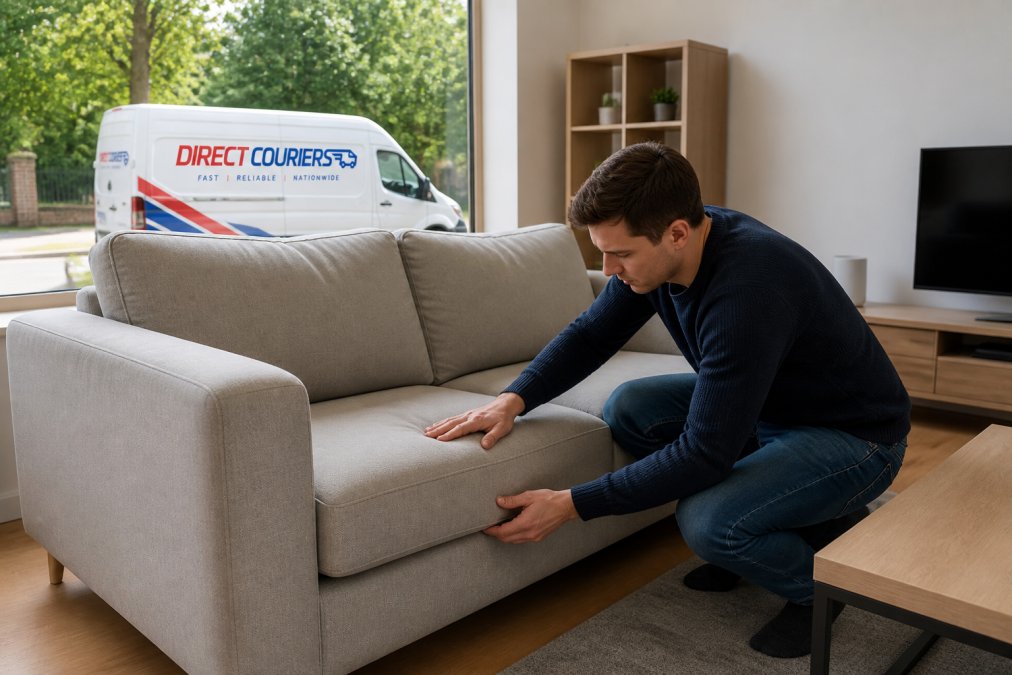
Work through this before the crew packs up their trolley:
- Check the packaging for dents, tears, water marks, or crushed corners
- Unwrap and inspect all surfaces, edges, and corners in daylight
- Test moving parts: drawers, recliners, hinges, legs, and swivel bases
- Check that all fixings, feet, and assembly parts are present
- Photograph any damage before the crew departs, with the van and paperwork in shot if possible
- Note faults on the delivery paperwork and ask the driver to sign and date it
- Confirm assembly is complete, level, and stable
- Keep the packaging until you are fully satisfied
What to do if you find damage
- Do not refuse the whole delivery unless the item is unusable. Refusing can complicate the claim and leave you without the item.
- Photograph everything, the damage, the packaging, the label, and the delivery note.
- Get the driver to record it on the paperwork and, where the courier offers it, in their app.
- Email the retailer or courier the same day with photos and your order number. Most firms have a short window (often 24-48 hours) for transit damage claims, so do not wait.
- Keep the packaging until the claim is resolved. Without it, some firms will not collect or replace.
Disposing of packaging without the headache
Cardboard, polystyrene, and shrink wrap pile up fast, and most household bins will not take them. A few practical routes:
- Flatten and recycle cardboard at your local household waste recycling centre. Most councils accept clean, flattened cardboard free of charge.
- Polystyrene is rarely kerbside-recyclable. Check your council's site, some accept it at recycling centres, many do not, so it may need to go in general waste.
- Shrink wrap and bubble wrap are usually general waste unless a supermarket offers a soft plastics collection point.
- Retailer take-back: some furniture retailers will collect packaging on a subsequent visit or accept it at the store. Ask before delivery day so you know the plan.
- Reuse: flattened cardboard is useful for protecting floors during decorating or for future moves. Store it dry.
The delivery is not finished when the van leaves. It is finished when you have inspected the item, noted any faults on the paperwork, photographed the evidence, and confirmed the packaging plan. Sign first and you weaken your claim.
Frequently Asked Questions
How long should I realistically wait for furniture delivery?
Standard furniture delivery lead times vary by retailer, typically ranging from 3 to 10 working days for in-stock items. Custom or made-to-order pieces can take 6 to 12 weeks. For faster service, same day furniture delivery services can dispatch within hours if you book early. Always check the delivery window provided at checkout and confirm the dispatch date with the retailer. If you need the item by a specific date, ask for a guaranteed delivery slot before ordering.
What steps can I take to speed up a furniture delivery?
To speed up your furniture delivery, start by completing a furniture delivery preparation checklist: clear pathways, measure all access points, and confirm someone will be home. Book same day furniture delivery services if urgency is high, and provide accurate contact details for the courier. Avoid rescheduling and ensure your address is easy to find. If you are selling online, have the item packed and ready for collection before the courier arrives.
How do I prepare my home for a large furniture delivery?
Preparation is key to avoiding delays. Clear a direct path from the entrance to the room where the furniture will go. Remove obstacles like rugs, plants, and small furniture. Measure doorways, stairwells, and lifts to confirm the item will fit. Protect floors and walls with covers if needed. If you live in a flat, check lift dimensions and book a lift if required. Have someone available to help the courier if necessary.
How can I track my furniture delivery effectively?
Most couriers provide a tracking link or delivery notification via text or email. Use this to monitor your order's progress in real time. If you are managing delivery expectations for high-value items, ask the courier for a specific delivery window and request a call ahead. Keep your phone accessible on delivery day. If you need to change the delivery date, contact the courier as soon as possible to avoid loading delays or missed slots.