 How-to
Hiring a Courier for Business Equipment: What to Check
Last Updated: November 15, 2026
Quick Summary
Before hiring a courier for business equipment, verify the goods-in-transit cover and maximum payout per consignment, declare the full replacement value, and confirm the vehicle type, tail-lift and weight capacity. Also get collection and delivery windows in writing and photograph the equipment and serial numbers before packing.
- Carrier liability and goods-in-transit cover are different protections and are not interchangeable.
- Declare replacement value rather than book value, as depreciation clauses can reduce a payout.
- Keep the crate, foam and straps until the claim is settled, since assessors may inspect packaging.
- A tail-lift Luton van suits palletised goods, heavy furniture and items too heavy to lift by hand.
- Record the name and registration of the collecting driver to support chain of custody.
Table of Contents
- Why Business Equipment Needs a Different Courier Checklist
- Courier Insurance for Business Equipment: Limits, Exclusions and Claims
- How to Pack Equipment for Courier Delivery
- Same-Day Courier for Business Equipment: When Speed Is Worth It
- Service Coverage, Vehicle Suitability and Delivery Windows
- Tracking, Proof of Delivery and Chain of Custody
- Courier Collection and Delivery Checklist
- Booking Your Business Equipment Courier
- Frequently Asked Questions
Why Business Equipment Needs a Different Courier Checklist
Hiring a courier for business equipment is not the same as sending a parcel.
A standard parcel network moves boxes.
Equipment often carries business-critical data, sits on a fixed installation date, and has a replacement lead time measured in weeks.
This guide covers the checks that matter, in the order we would make them: vetting, service tiers, and packing that survives a tail-lift.
Courier Insurance for Business Equipment: Limits, Exclusions and Claims
Courier insurance for business equipment is the cover that pays out if goods are lost or damaged in transit. The cover is only as good as its limits and exclusions, so verify the policy wording before you book, not after something breaks.
Most complaints start the same way: the courier was insured, but the payout did not cover the replacement cost. That happens for three reasons.
- Low declared value. Cover is usually tied to the value you declare at booking. Under-declare to save money and you cap your own claim.
- Exclusions for used or fragile goods. Second-hand equipment, glass-fronted items and anything packed by the customer are common exclusions.
- Inadequate packaging clauses. If the courier decides your packaging was not fit for purpose, the claim can be refused.
Carrier liability versus goods-in-transit cover
There are two different protections and they are not interchangeable.
Ask which applies to your booking. If it is carrier liability only, check the cap against the replacement value. A cap that is a fraction of the replacement cost is not cover in any practical sense.
A practical checklist for verifying cover
Before you book, get written answers to these questions:
- Maximum cover per consignment. Is it a fixed sum, or a percentage of declared value? Is there a per-item cap as well as a per-consignment cap?
- Declared-value limit. What is the highest value the courier will accept on a single booking, and what happens if your equipment exceeds it?
- Exclusions. Ask specifically about used equipment, calibrated instruments, glass or screens, items packed by the customer, and consequential loss such as missed installation dates or lost productivity.
- Excess. What is the excess per claim, and does it apply per item or per consignment?
- Territorial and journey limits. Does cover apply for the full route, including any overnight depot storage, and are there restrictions on multi-day or palletised movements?
- Who inspects damage. Is it the courier's own assessor, an independent loss adjuster, or the recipient? How quickly must damage be reported?
- Claims response time. What is the stated turnaround from claim submission to decision, and is it in the contract or only in a policy document you have not seen?
How the claims process actually runs
A claim usually follows a fixed sequence, and knowing it in advance separates a paid claim from a rejected one.
- Notification window. Most policies require damage or loss to be reported within a short window after delivery, often a matter of days. Diarise the deadline at delivery, not when you unpack.
- Evidence pack. Expect to supply timestamped photographs of the equipment before packing, photographs of the packaging and the damage, the signed proof of delivery, the serial number, and the original invoice or a replacement quote.
- Inspection. The courier or its adjuster may inspect the packaging before it is discarded. Keep the crate, foam and straps until the claim is settled.
Watch out: discarding the packaging before an inspection is a common reason a legitimate claim stalls, because the assessor cannot verify whether the packaging was fit for purpose.
If you want to understand how transit cover works in detail before you commit, our guide to courier transit insurance and what it covers explains limits, exclusions and the claims process step by step.
How to Pack Equipment for Courier Delivery
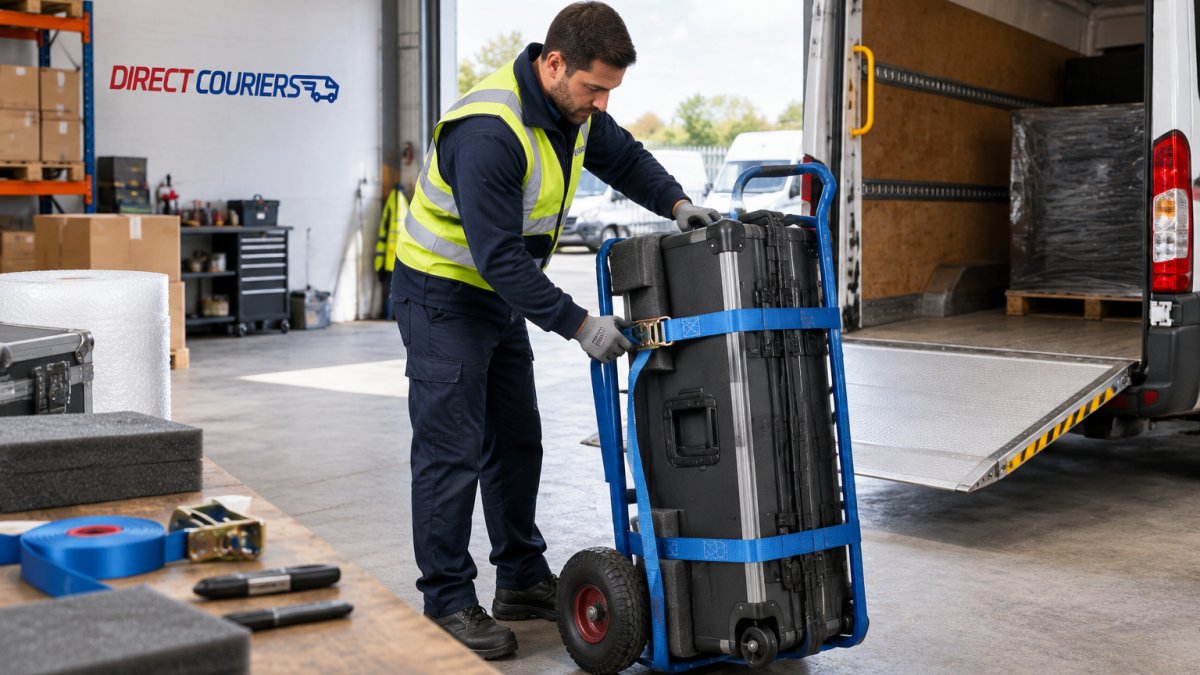
Pack equipment for courier delivery by immobilising it inside a rigid outer case, cushioning every face, and labelling the weight and orientation clearly.
Start with a risk assessment, not a box
Before you choose packaging, classify the item on four axes. Each changes what the courier needs to know and what the packaging must withstand.
- Fragility. Screens, glass fronts, exposed circuit boards and calibrated instruments are shock-sensitive. Note the manufacturer's specified orientation and whether the item can tolerate being laid flat.
- Value. High-value items need declared value, named handlers and tamper-evident sealing, not just padding.
- Size and weight. Anything that cannot be lifted by one person needs a tail-lift, a pallet or a two-person crew. Record weight in kilograms and dimensions in centimetres.
A short written risk note, item, weight, dimensions, fragility, value, handling instructions, is the most useful document you can hand the driver.
A method that works for most business equipment
- Photograph the item before packing. Timestamped photos of the equipment, its serial number and any existing marks are your first piece of claim evidence.
- Use the original crate or box where possible. Manufacturers design packaging for the exact shock loads the item can take. If the original is gone, match its internal bracing rather than substituting a generic box.
- Cushion all six faces. Foam or bubble wrap on every side, with no gaps that let the item shift. Corner protection matters more than flat-face padding because corners take the first impact.
- Immobilise the load. Fill voids so nothing moves when the case is tilted. Ratchet straps and bungee cords secure the case to the vehicle.
- Seal tamper-evidently. Numbered security seals or tamper-evident tape give you a documented handover point and make interference visible.
- Label weight, orientation and fragility. A clear "this way up" and the weight in kilograms helps the driver plan the lift. Add the consignment reference and a contact number.
Equipment-specific handling notes
- Servers and IT equipment. Remove loose cables and external drives, brace internal components where the manufacturer allows, and keep the item upright if specified. Anti-static bags for boards and drives.
- Calibrated instruments. Protect the calibration, not just the casing. Keep the certificate with the item, avoid extreme temperatures, and tell the courier the item must not be dropped or inverted.
- Screens and glass-fronted equipment. Face the screen inward, use rigid corner braces, and never rely on bubble wrap alone for a large panel.
Loading, lifting and environmental requirements
Packing is only half the job; the load has to get on and off the vehicle safely.
Environmental conditions matter for sensitive equipment. A van in direct sun or an unheated depot overnight can push temperatures outside the manufacturer's operating range.
Watch out: packing equipment yourself and skipping the photos is the single most common reason a damage claim fails.
Same-Day Courier for Business Equipment: When Speed Is Worth It
The test is simple: ask what a day of downtime costs. When downtime makes speed worthwhile, reliable handling matters just as much, so Dabbous Mega Supplies can help frame what to check before arranging office equipment delivery.
Same-day also reduces handling. The item goes from your premises to the destination with fewer touchpoints and less time in transit, lowering the risk of damage.
For a full explanation of how the service works, read our guide to how same-day deliveries work before you decide whether the speed is worth the premium.
Service Coverage, Vehicle Suitability and Delivery Windows
Vehicle suitability is where equipment moves go wrong most often. A compact van suits boxed IT equipment.
Our van fleet ranges from compact vans to tail-lift Luton vans, so you can match the vehicle to the weight and dimensions of what you are moving rather than hoping it fits.
Delivery windows deserve the same attention. A broad window is fine for a warehouse, but not when a site team is waiting or a customer has taken a day off.
| Service tier | Best for | Speed | Handling | Typical use |
|---|---|---|---|---|
| Same-day dedicated | Urgent, high-value equipment | Hours | Direct, few touchpoints | Server replacements, instruments |
| Next-day | Scheduled business moves | Overnight | Depot-sorted | Office relocations |
| Scheduled | Planned stock and pallets | Chosen date | Planned loading | Regular replenishment |
| Pallet or part-load | Bulky, heavy goods | Multi-day | Forklift and tail-lift | Machinery, furniture |
Tracking, Proof of Delivery and Chain of Custody
Tracking, proof of delivery and chain of custody are the three records that let you prove where equipment was, who had it, and when it arrived. For high-value goods, they are as important as the insurance itself.
Real-time tracking tells you where the vehicle is, so you can answer your own clients when they ask for updates.
Ask your courier how access is controlled at collection and delivery. Who signs equipment out? Are premises access times recorded?
For a closer look at what live tracking gives you, our guide to real-time courier tracking benefits sets out how it supports chain-of-custody records.
Courier Collection and Delivery Checklist
Use this checklist before every equipment collection. It takes ten minutes and prevents most of the problems that turn into claims.
- Confirm the courier's goods-in-transit cover and the maximum payout per consignment
- Declare the full replacement value, not the depreciated value
- Photograph the equipment and serial numbers before packing
- Confirm the vehicle type, tail-lift and weight capacity
A common mistake is treating the booking confirmation as the whole agreement. The service commitments, cover limits and claims terms are the parts that matter when something goes wrong.
Booking Your Business Equipment Courier
Book once you have confirmed cover, vehicle, window and tracking, and have the collection address and access details ready.
Give the courier the weight and dimensions, the number of items, whether a tail-lift is needed, and any site access restrictions such as loading bays, parking or lift sizes.
When you are ready, you can review our courier service and arrange a collection for same-day or next-day delivery across the country.
Frequently Asked Questions
What should I check before hiring a courier for business equipment?
Start with insurance: ask for the goods-in-transit cover limit per item and per consignment, plus the excess and exclusions. Confirm vehicle suitability for the weight and dimensions, whether a tail lift and two-person crew are included, and what written service-level commitments apply to collection windows and delivery deadlines. Check tracking, proof of delivery and how claims are handled. Get the quote in writing with any surcharges listed, then work through a collection and delivery checklist before the driver arrives.
What insurance should a courier have for business equipment?
Ask for goods-in-transit cover that names the actual replacement value of your equipment, not just a headline figure. Check the per-item limit, because high-value goods often sit above a standard cap, and confirm the excess you would pay on a claim. Read the exclusions: inadequate packaging, undeclared values and prohibited items are common reasons claims are refused. Ask how quickly claims are acknowledged and what evidence is needed, such as photos at collection and a signed proof of delivery.
Can a courier transport heavy or awkward business equipment?
Yes, provided the vehicle and crew match the load. Tell the courier the weight, dimensions and whether the item is crated or on a pallet, then confirm whether a tail-lift Luton van and a two-person team are being sent. Equipment that needs secure loading with ratchet straps or a furniture trolley should be flagged at booking. If access at either end involves stairs, lifts or narrow doorways, say so, because that affects the crew size and the time slot you are quoted.
Should I use a same-day or next-day courier for business equipment?
Same-day courier for business equipment suits urgent replacements, site installations and items that cannot sit in a depot overnight, such as calibrated instruments or equipment tied to a contract deadline. Next-day or scheduled delivery usually costs less and works for planned office moves and stock replenishment. Compare the delivery window each option gives you, not just the day, and ask what remedy applies if the window is missed before you commit.