 ultimate-guide
Real Time Courier Tracking Benefits: A 2026 Guide
Table of Contents
- Real Time Courier Tracking Benefits: Why Live Visibility Matters
- How Real Time Tracking Works, and What Courier Tracking Software Features Make It Possible
- Last Mile Delivery Visibility: Where Tracking Delivers the Biggest Operational Gains
- Improving Customer Experience With Delivery Tracking: Trust, Loyalty, and Fewer Wasted Trips
- Cost Reduction and Operational Efficiency Through Tracking Data
- The Angles Competitors Miss: Sustainability, Data Security, and Scale
- Conclusion
- Frequently Asked Questions
Last Updated: October 4, 2026
Real Time Courier Tracking Benefits: Why Live Visibility Matters
Real time courier tracking is the practice of monitoring a shipment's location and status continuously from collection to delivery, using GPS and connected software rather than end-of-day updates. The benefits are practical: fewer failed deliveries, calmer customers, and tighter control over your own schedule.
We run a fully insured fleet at Direct Couriers London Ltd, from compact vans to tail-lift Luton vans, and live tracking sits at the centre of how we operate. Below, we'll show you exactly where that visibility pays off, what to look for in courier delivery tracking software features, and the parts of the picture most guides skip: data security, sustainability, and how the maths changes as you scale.
How Real Time Tracking Works, and What Courier Tracking Software Features Make It Possible
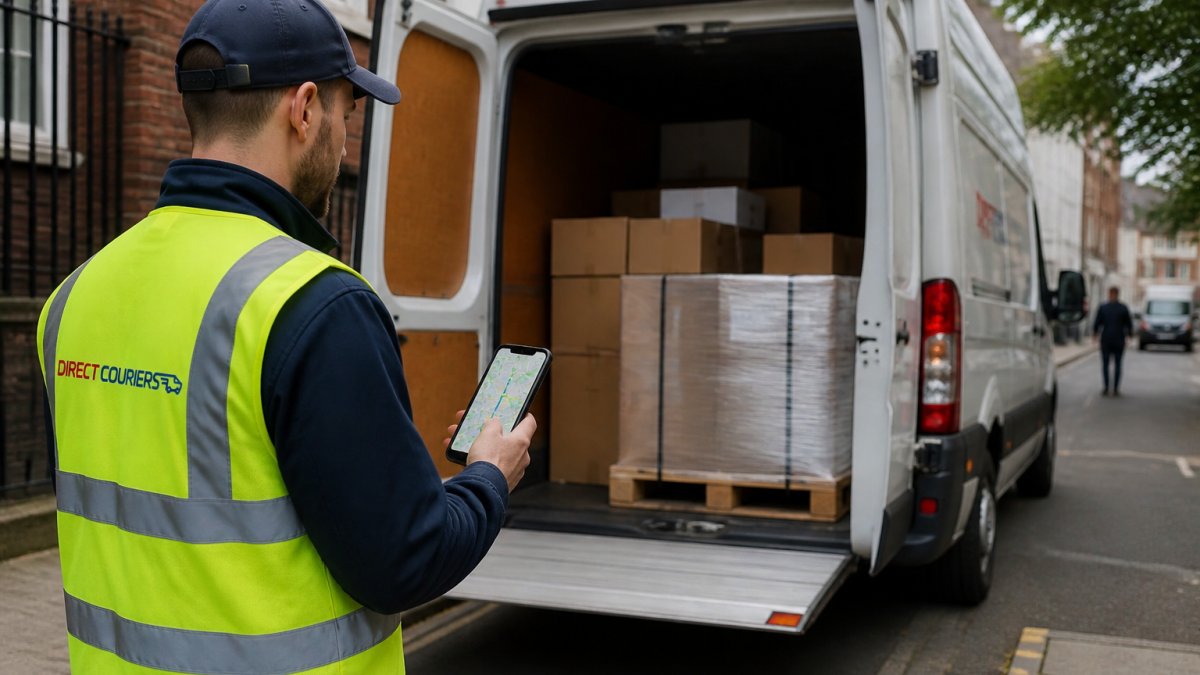
Live tracking works by combining GPS hardware, a mobile data connection, and a delivery management system that turns raw location pings into readable status updates for customers and dispatchers. Each vehicle or parcel reports its position at short intervals, and the platform converts that stream into delivery ETAs, automated notifications, and exception alerts.
The practical difference between a good system and a basic one comes down to what it does with that data. A cheap tracker shows a dot on a map. A proper platform predicts arrival windows, flags delays before the customer notices, and feeds route optimisation.
The Core Features to Look For in a Tracking Platform
- Real-time GPS tracking with updates measured in seconds, not hours
- Automated notifications triggered by status changes, not manual texts
- Delivery ETAs recalculated as traffic and route conditions change
- Proof of delivery captured digitally at the doorstep
- Route optimisation that reorders stops based on live conditions
- A customer-facing tracking link that works without an app download
Last Mile Delivery Visibility: Where Tracking Delivers the Biggest Operational Gains
The last mile is where most delivery problems actually happen, and it's where last mile delivery visibility earns its keep.
The gains show up in three places. First, fulfilment accuracy: digital proof of delivery and timestamped scans cut disputes about whether an item arrived.
For bulky goods, this matters more than for small parcels. A furniture delivery that fails means a wasted two-person crew, a wasted slot, and a rearranged date. Live tracking turns that into a phone call before the van leaves the depot.
| Operational problem | What tracking changes | Practical impact |
|---|---|---|
| Failed deliveries | Live ETA shared with the customer | Fewer wasted trips and redeliveries |
| Disputed deliveries | Digital proof of delivery | Fewer "it never arrived" claims |
| Idle capacity | Real-time fleet visibility | Better resource allocation |
| Manual customer updates | Automated notifications | Fewer inbound status calls |
Improving Customer Experience With Delivery Tracking: Trust, Loyalty, and Fewer Wasted Trips
Improving customer experience with delivery tracking comes down to one thing: removing uncertainty. Most buyers don't need their sofa in an hour. They need to know it's coming, roughly when, and that someone will tell them if that changes.
That predictability builds brand loyalty in a way that discounts rarely do.
There's a commercial angle too. Every failed delivery costs you twice: once in the wasted trip, and again in the customer's lost confidence.
What Changes With Scale, and What Doesn't
Most guides treat 'the customer' as one undifferentiated person. In practice, the tracking experience that builds trust looks quite different depending on your volume:
- Small businesses (a handful of shipments a week). The customer often knows you personally. What builds trust here is a tracking link that works without an app download, a named contact, and a realistic window rather than a vague 'sometime today'. Over-engineering this with a customer portal nobody logs into is a common and expensive mistake.
- Growing operations (dozens of drops a day). The bottleneck shifts to consistency. Customers start comparing you to the national carriers, so automated notifications and a self-service tracking page stop being nice-to-haves and become the baseline. This is where a shared live view between dispatchers and customers pays for itself.
- Enterprise scale (hundreds of drops a day). Trust is now a systems problem. Customers expect API access so tracking data flows into their own order management, predictive ETAs, and a single point of contact when something goes wrong. The mistake here is staying on a manual system long past the point it's costing more than the software would.
The underlying benefit, certainty, doesn't change with size. The implementation does.
The Privacy Side of Trust
There's a dimension of customer trust that almost no tracking guide addresses: the data itself. Under UK data protection law, that data must be handled lawfully, stored securely, and kept only as long as needed. Information Commissioner's Office guidance on data protection sets out the principles that apply.
Customers increasingly notice this. A tracking link that exposes a full address to anyone who guesses the URL, or a courier who can't say how long they retain location history, undermines the very trust the tracking was meant to build.
Cost Reduction and Operational Efficiency Through Tracking Data
Cost reduction through route optimisation starts with data you already have but probably aren't using. Every completed delivery generates a record: time on site, distance travelled, stops per hour, delay causes, and idle time at the kerb.
The pattern is usually the same. A handful of postcodes consistently take longer than planned. Certain times of day are reliably slower, school-run windows, market-day closures, the 4pm hospital shift change. A few customers are never ready when the van arrives.
Where the Money Actually Leaks
It helps to break delivery cost into four buckets, because tracking data hits each one differently:
- Failed and re-attempted deliveries. A failed drop isn't just one wasted trip; it's the original journey, the return leg, the redelivery, and the customer-service time in between. Live ETAs and pre-arrival notifications are the single highest-leverage fix here, because they let the customer meet the van rather than the other way round.
- Fuel and mileage. Route optimisation trims total distance, but the bigger saving is usually in idling and in backtracking caused by poor sequencing. A van that sits outside a building for twelve minutes with the engine running burns more than the detour it avoided.
- Driver hours. More stops per shift means either fewer shifts for the same volume or more capacity from the same headcount. For a small operation running two vans, one extra stop per hour across an eight-hour day is meaningful.
- Admin and dispute handling. Timestamped scans and digital proof of delivery replace the phone calls, emails, and credit notes that follow a disputed drop.
Route Optimisation and Capacity Utilisation
Route optimisation uses that history to sequence drops in the order that minimises total distance and time, not the order jobs were booked.
The two work together. Better sequencing means more stops per shift. Better vehicle matching means fewer half-empty runs. For a small operation, that's the difference between a profitable week and a break-even one. For a larger one, it's the difference between needing a fourth van and sweating the three you have.
The Sustainability Angle Most Guides Skip
Here's the part competitors leave out: the same levers that cut cost also cut carbon. Fewer failed deliveries, fuller vans, and shorter routes all mean fewer kilometres driven per parcel, and kilometres driven is the dominant emissions factor in last-mile logistics.
That makes route optimisation and capacity utilisation dual-purpose tools. They're not just cost controls; they're the most practical emissions-reduction levers available to a courier-dependent business, and they require no new hardware beyond the tracking you're already paying for.
UK government guidance on moving goods and logistics
The Angles Competitors Miss: Sustainability, Data Security, and Scale
Sustainability impact and data privacy are the two topics most tracking guides avoid, largely because they're harder to reduce to a bullet list. Both matter more every year.
On sustainability, the link is direct: fewer failed deliveries and fuller vans mean fewer kilometres driven per parcel. Route optimisation and capacity utilisation aren't just cost tools; they're emissions tools.
On security, live tracking means location data about your customers and your vehicles. Under UK data protection law, that data must be handled lawfully, stored securely, and kept only as long as needed. Information Commissioner's Office guidance on data protection sets out the principles that apply.
Small Business vs Enterprise: What Changes With Scale
The underlying benefits don't change with size, but the implementation challenges do. A small seller doing five to ten shipments a month needs a tracking link and a reliable collection, not a bespoke integration. An enterprise running hundreds of drops a day needs API access, centralised planning, and predictive analytics layered on top.
The mistake small businesses make is buying enterprise complexity they'll never use. The mistake larger ones make is staying on a manual system long past the point it's costing them more than the software would.
Conclusion
Getting real time courier tracking right is less about the software and more about whether the visibility actually reaches the people who need it: your dispatchers, your customers, and you. Most delivery problems aren't mysteries; they're just invisible until someone switches the lights on.
At Direct Couriers London Ltd, we build tracking into every job as standard, backed by a fully insured fleet and same-day and next-day services across the UK.
Contact us today to arrange your next delivery.
Frequently Asked Questions
What are the main benefits of real time courier tracking?
Real time courier tracking gives you live visibility of every shipment, which reduces failed deliveries, cuts the number of 'where is my order' calls, and lets you plan around accurate delivery ETAs. It also provides the data you need for route optimisation and capacity planning. For businesses shipping bulky or high-value items, the trust and reliability that come from sharing live updates often translate into repeat purchases and stronger brand loyalty.
How does real time tracking improve last mile delivery visibility?
Last mile delivery visibility improves because GPS tracking and IoT-enabled sensors report a vehicle's position continuously, not just at scan points. Dispatchers can see delays as they happen and send automated notifications to customers before they call in. That means fewer wasted trips, more accurate delivery ETAs, and the ability to reallocate resources when a route falls behind. The result is a tighter final leg and fewer fulfillment errors.
What features should I look for in courier delivery tracking software?
Look for live GPS tracking, automated notifications, a customer-facing tracking page, and integration with your order management system. The software should also give you historical data for route optimisation and capacity utilisation. If you handle high-value goods, check how the platform handles data privacy and access controls. A system that only shows a status label, such as 'in transit', is not real time tracking.
Is real time tracking worth it for a small e-commerce seller?
Yes. Small sellers often feel the pain of a missed delivery more acutely because every customer matters. Real time tracking lets you answer queries quickly, reduce stockout panic, and show buyers you are on top of their order. Many courier tracking platforms now offer pay-as-you-go or low-volume plans, so you do not need enterprise-scale shipping to get live visibility. The main benefit is protecting your reputation when you cannot afford to lose a single sale.