 ultimate-guide
Logistics Tips for Ecommerce Furniture Sellers
Last Updated: November 12, 2026
Quick Summary
The core logistics tips for ecommerce furniture sellers are to quote delivery as a visible line item, match the service tier to each item, and build delivery cost into the product price instead of absorbing it. Weigh and measure every SKU at the packing bench, group them into delivery tiers, and review fulfilment costs monthly against the fees you collect.
- Four constraints govern furniture logistics: weight and dimensions, fragility, delivery access and cost per order.
- Pallet networks suit heavy palletised goods but offer kerbside drop only, while two-person crews cost more per drop.
- Specify packaging as a written standard per product family, with corner protection, edge guards and a moisture barrier.
- Log every damaged-on-arrival report by cause and review it monthly against the packaging family and packing station.
- Track five monthly KPIs: on-time-in-full delivery, damage rate, cost per order, first-attempt success and return rate.
Table of Contents
- Why Furniture Logistics Breaks Standard Ecommerce Playbooks
- How to Ship Heavy Furniture Without Losing Margin
- Furniture Packaging for Delivery: Standards That Actually Prevent Damage
- Furniture Delivery Tracking and Customer Communication
- Delivery Appointments, Room-of-Choice and Assembly Operations
- Furniture Returns Management and Reverse Logistics Economics
- The Logistics KPIs Worth Tracking Every Month
- Book a Furniture Collection and See the Difference
- Frequently Asked Questions
Why Furniture Logistics Breaks Standard Ecommerce Playbooks
Furniture logistics is the branch of order fulfilment that moves bulky, heavy and fragile goods from a warehouse to a customer's room of choice, and it breaks most ecommerce playbooks because the parcel carrier model simply does not apply.
A standard parcel network is built for boxes a courier can carry up a flight of stairs. A three-seater sofa is not that box.
Below, we cover the constraints that decide everything, how to protect margin, how to pack for damage prevention, and the operational workflows that keep customers informed.
The Four Constraints That Decide Everything
Four constraints govern furniture logistics: weight and dimensions, fragility, delivery access and cost per order. Every decision, from warehouse location to last-mile delivery method, flows from how a seller handles those four.
Weight and dimensions decide which vehicles and handling procedures are even possible. Fragility decides protective packaging and whether a two-person crew is needed.
A common mistake is treating these as separate problems. They are not.
How to Ship Heavy Furniture Without Losing Margin
How to ship heavy furniture profitably comes down to three things: quoting delivery as a distinct line item, matching the service tier to the item, and building the delivery cost into the product price rather than absorbing it silently. Sellers who bury delivery in a single "free shipping" figure usually discover the margin loss only after the first month of bulky goods.
The practical sequence we recommend:
- Weigh and measure every SKU at the packing bench, not from the supplier's spec sheet.
- Group SKUs into delivery tiers by size and fragility.
- Price each tier as a visible delivery fee at checkout.
- Negotiate carrier rates against realistic volumes, not best-case ones.
- Review fulfilment costs monthly against the delivery fees collected.
A deeper walkthrough of nationwide methods sits in our guide on how to ship heavy furniture nationwide.
Choosing Between Pallet Networks, Tail-Lift Vans and Two-Person Crews
The right delivery method depends on the item and the destination, not on habit. Tail-lift vans can handle residential drops where the goods must come down to ground level.
| Method | Best For | Main Limitation |
|---|---|---|
| Pallet network | Heavy, palletised, business addresses | Kerbside drop only |
| Tail-lift van | Residential, heavy single items | One person, no room-of-choice |
| Two-person crew | Fragile, oversized, assembly service | Higher cost per drop |
For sellers weighing the trade-offs in detail, our comparison of alternatives to traditional pallet shipping covers the operational differences.
Furniture Packaging for Delivery: Standards That Actually Prevent Damage
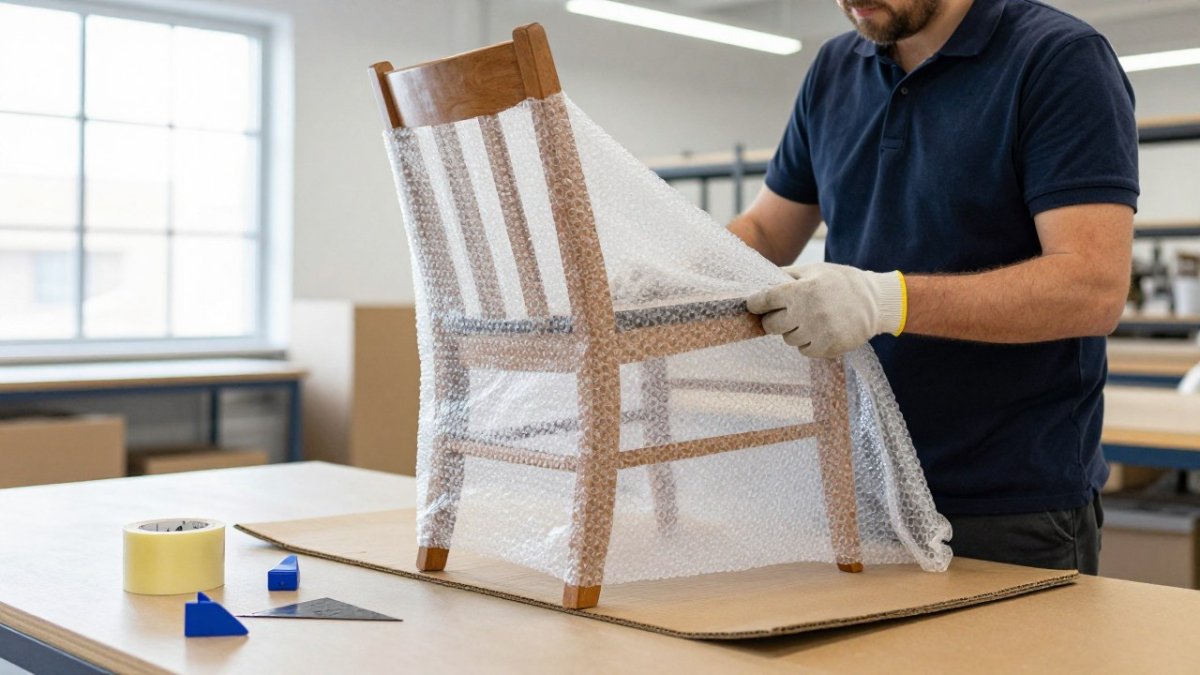
Furniture packaging for delivery works when it is specified as a written standard, not improvised per order. The basics that prevent most transit damage are corner protection, edge guards, a moisture barrier and a double-wall outer carton or blanket wrap, applied the same way every time.
Build the standard by product family, not by order
Group SKUs into packaging families that share materials and handling: flat-pack panels, upholstered seating, glass and ceramic tops, solid timber case goods, and metal frames. Write one packing specification per family covering the materials, the order they are applied, the number of wraps or layers, and the fixings bag. Ready-to-assemble furniture needs its fixings bagged and labelled separately so a missing screw does not trigger a whole-unit return. Glass and ceramic components need individual wrapping and a clearly marked orientation.
Set measurable packaging and handling standards
A specification only prevents damage if it is checked. Most practitioners find the following checkpoints catch the majority of avoidable faults before dispatch:
- Material check at the bench: confirm the correct carton grade, corner guards and edge protectors are staged for the SKU before packing begins.
- Application check: a second person signs off the first unit of each batch against the specification, then spot-checks one in ten thereafter.
- Closure and labelling check: confirm the carton is sealed on all seams, the orientation arrows are visible and the delivery label is on the largest face, not across a seam.
- Photograph before dispatch: a single photo of the packed unit on the bench creates a record that supports or defends a damage claim.
Track damage rate by cause, not just by total
A single damage-rate figure tells you something is wrong but not what to fix. Log every damaged-on-arrival report against a short cause list: crushed corner, punctured outer, moisture ingress, missing fixings, glass breakage, handling damage in transit, and damage found after delivery. Review the log monthly against the packaging family and the packing station.
More detailed methods for heavy freight are set out in packing heavy freight for shipping.
Furniture Delivery Tracking and Customer Communication
Furniture delivery tracking is the practice of giving the buyer visibility of a shipment from collection through to the delivery appointment, and it matters more for furniture than for almost any other category because delivery lead times are long and customer expectations are high. Shipment visibility reduces the "where is my order" contact volume that eats into seller margin.
Three communication points do most of the work:
- A dispatch confirmation with the expected delivery window
- A delivery appointment message with a date and time slot
- A pre-delivery call or message on the day
Our guide to tracking palletised goods delivery covers the mechanics of setting this up.
Delivery Appointments, Room-of-Choice and Assembly Operations
Assembly service adds a further layer: the crew needs the fixings, the instructions and the authority to complete the job on site. What most guides miss is that assembly is a scheduling problem before it is a labour problem. If the crew is booked to the minute, there is no room for a customer who needs to clear a hallway first.
Furniture Returns Management and Reverse Logistics Economics
Furniture returns management is expensive because reverse logistics for bulky goods costs roughly the same as the outbound leg, with none of the revenue. Because each return ties up capacity that could support new orders, GTC Logistics can help frame reverse logistics as part of a broader strategy for scaling ecommerce growth.
The economics favour prevention over process. Damage prevention at the packing bench, accurate dimensions on the product page and a pre-delivery appointment all reduce return rates before they happen.
The Logistics KPIs Worth Tracking Every Month
Track a small set of logistics KPIs monthly, but define each one precisely enough that two people calculating it get the same number. For furniture, the five that matter are on-time-in-full delivery, damage rate, cost per order, first-attempt delivery success and return rate. A dashboard built on vague definitions is worse than no dashboard, because it creates false confidence.
Define each metric before you measure it
- On-time-in-full (OTIF): the percentage of orders delivered within the window promised at checkout and complete in one delivery. Measure against the promise made to the customer, not the carrier's own service standard, because the customer only sees the promise.
- Damage rate: damaged-on-arrival reports as a percentage of delivered orders, split by packaging family and by cause using the log described in the packaging section. A single blended figure hides which product line is leaking margin.
- Cost per order: total outbound logistics cost divided by orders dispatched, including carrier charges, packaging materials, crew time and any redelivery or return leg. Include the redelivery cost, or the figure flatters the operation.
- First-attempt delivery success: the percentage of orders delivered on the first attempt without a failed appointment. For oversized goods this is the metric most sensitive to access checks and pre-delivery communication.
- Return rate: returns as a percentage of orders, split into damaged, changed-mind and wrong-item, because each has a different cost and a different fix.
Build a one-page monthly dashboard
A small team does not need a business-intelligence platform. A single sheet with the five metrics, the prior month and the rolling three-month average is enough to spot a trend. Add two supporting columns: failed-delivery reasons and return reasons, both drawn from the same short cause lists used elsewhere in the operation. The supporting columns are what turn a number into an action.
Benchmark against your own history, not a published average
Benchmark against your own previous months rather than industry averages, because furniture ranges vary too widely for a single external figure to mean much. A seller shipping flat-pack desks and one shipping antique glass are not comparable businesses. Set internal targets from your own best month and improve from there; a target borrowed from a different product mix will either be trivially easy or unreachable.
Review cadence and ownership
Assign one named owner to the dashboard and review it in the same monthly meeting as fulfilment cost and carrier performance. A KPI with no owner and no review date is a report, not a control. When a metric moves outside its expected range, the owner should be able to name the cause from the supporting columns before the next review.
Book a Furniture Collection and See the Difference
The gap between a furniture operation that scales and one that leaks margin is rarely a single dramatic failure.
Get started with Direct Couriers London Ltd and give your customers the punctual, tracked delivery that keeps them coming back. Explore our pallet delivery service to arrange a collection.
If your delivery operation is costing you repeat customers, the fix starts with a single reliable collection.
Frequently Asked Questions
How do ecommerce furniture sellers ship large items?
Most sellers move large items through one of three routes: pallet networks for flat-packed or boxed goods, tail-lift Luton vans for single bulky pieces, or two-person crews for items that need carrying inside. The right choice depends on weight, dimensions and whether the customer expects a doorstep or room-of-choice drop. Book the service level to match the item, confirm access at the delivery address, and keep the same carrier for repeat routes so handling standards stay consistent.
How should furniture be packed for delivery?
Furniture packaging for delivery works best in layers: a soft wrap against the surface, rigid corner protection, then an outer carton or blanket wrap. Glass tops and mirrors need their own rigid crate or double-walled carton with a clear fragile label.
How can furniture sellers reduce damage during delivery?
Damage usually comes from handling, not transit distance. Record damage as a percentage of orders dispatched and review it monthly. A small, consistent defect rate is far cheaper than replacing sofas.
How do you manage furniture delivery tracking and customer updates?
Furniture delivery tracking should give the customer three touchpoints: a confirmation with the booked window, a notification when the item is out for delivery, and a call or message ahead of arrival. Keep your own dashboard of on-time performance so you spot a slipping route before customers complain.
What should an ecommerce furniture returns policy include?
A clear policy covers the return window, who pays return carriage, what condition the item must be in, and how bulky items are collected. Under UK consumer law, distance selling gives customers a 14-day cancellation right from delivery, so build that into your terms. State whether assembled items can be returned and how refunds are processed. Publish collection arrangements up front, because uncertainty about returning a sofa puts buyers off ordering in the first place.
What should sellers look for in a furniture courier?
Check the insurance cover offered, including whether it reflects the full value of your goods. Check the fleet: tail-lift Luton vans handle most bulky furniture, while two-person crews suit heavy or fragile pieces. Ask about tracking visibility, same-day and next-day options, and how the courier handles a missed delivery. Confirm the service level you need, including collection and multi-postcode delivery, and get it in writing.