 ultimate-guide
Reliable Same Day Delivery Services London: 2026 Guide
Table of Contents
- What Makes Same Day Delivery Actually Reliable
- Same Day Pallet Delivery: Weight Limits, Vehicles and Costs
- How to Book a Same Day Courier in Under 10 Minutes
- Courier Insurance Requirements for High-Value Goods
- Service Coverage: Central London Postcodes and Beyond
- Cutting Costs and Meeting ULEZ Rules on High-Volume Shipments
- Frequently Asked Questions
Last Updated: September 11, 2026
What Makes Same Day Delivery Actually Reliable
Same day delivery is a courier service that collects a parcel, pallet or piece of furniture and delivers it to a different address within the same working day, usually within a defined collection and drop-off window agreed at booking. Reliability is not about speed claims: it is whether the courier turns up inside the promised collection window, whether the item arrives undamaged, and whether the sender can prove both.
The gap between a reliable same day delivery service and a cheap one shows up in three places: dispatch discipline, tracking, and proof of delivery.
Collection Times and Dispatch Windows
A genuine same-day service works to a fixed dispatch window, not a vague "sometime today" promise. Book before the cut-off and the job is scheduled into a route immediately; book after it and you are realistically looking at next-day. Ask any provider for their cut-off in writing before you commit, because every downstream delay traces back to a late pickup.
Real-Time Tracking and Proof of Delivery
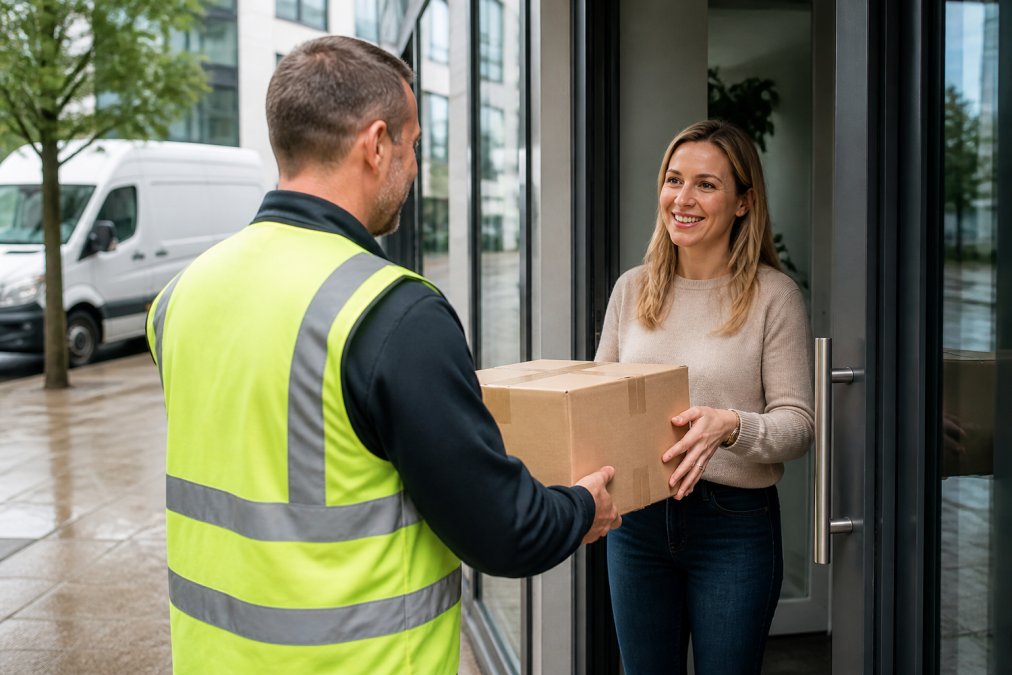
Real-time tracking is a live location feed and status log for a job, accessible to both sender and recipient. Proof of delivery is the signed or photographed confirmation that closes the job. Together they answer the only question that matters when a client is chasing you: where is my goods right now? A courier network that cannot give you both is not one you can build a business around. As guidance from the Information Commissioner's Office on handling delivery data makes clear, tracking data that identifies recipients has to be handled lawfully, so it is fair to ask a provider how they store it.
Same Day Pallet Delivery: Weight Limits, Vehicles and Costs
Same day pallet delivery moves goods on a standard pallet footprint using a vehicle with the correct tail-lift or forklift capability for the load. The limiting factor is rarely distance; it is the weight, dimensions and access at both ends. Pricing depends on pallet count, total weight, vehicle type, postcodes and waiting time, so always request a quote against your actual load rather than a headline rate.
| Vehicle | Typical Load | Best For |
|---|---|---|
| Cargo bike | Small parcels, documents | Dense central postcodes, ULEZ-compliant runs |
| Compact van | Up to around a dozen boxes | Single-office moves, small e-commerce orders |
| Long-wheelbase van | Bulky furniture, multiple pallets | Antiques, flat-pack furniture, stock transfers |
| Tail-lift Luton van | Full pallet loads, heavy equipment | Pallets, machinery, multi-item relocations |
Choosing the Right Vehicle for Your Load
Match the vehicle to the load before you book, because a wrong-sized van means a failed collection and a rebooked slot. A dedicated vehicle is worth the premium when goods are fragile, high-value or need to arrive by a fixed time. For a single antique sofa, a long-wheelbase van with blankets and straps is the sensible call; for three pallets of stock, a tail-lift Luton is the only realistic option.
How to Book a Same Day Courier in Under 10 Minutes
Booking a same day courier takes under ten minutes when you have the collection and delivery details, load dimensions, weight and access notes ready before you start. Have the following to hand:
- Full collection address, including floor and lift access
- Full delivery address and any parking restrictions
- Number of items, plus dimensions and approximate weight
- Whether a tail-lift or two-person lift is required
- Declared value of the goods, for insurance
- Recipient name and contact number
- Your required delivery window
What to Have Ready Before You Book
The single most common mistake is under-declaring weight. A van that arrives for "a few boxes" and finds a piano wastes everyone's afternoon. If unsure, describe the item honestly and let the courier size the vehicle. For business-to-business work, confirm whether an SLA applies and what the agreed collection time actually is.
Booking by Phone, Email or Online Portal
Most providers offer three booking routes, and the right one depends on how repeatable your jobs are. Phone suits one-off, unusual loads where you need to talk through access or handling. Email suits jobs needing a paper trail, such as purchase orders or client references. An online portal suits regular shippers who want saved addresses, stored load profiles and a booking history they can reconcile against invoices.
For account customers, the speed gain comes from saved templates: a named collection address, a default vehicle type and a standing delivery window mean a repeat job can be raised in under a minute. Ask any provider whether they offer account templates and whether your booking history is exportable as a CSV.
Integrating Same Day Delivery with Your E-commerce Platform
If you sell through an online store, the manual step of copying an order into a courier booking form is the single biggest source of admin error and delay. The fix is an integration between your order system and the courier's booking API.
In practice, the common patterns are:
- Shopify: apps in the Shopify App Store can push new orders to a courier's API and write the tracking number back to the order timeline automatically. Look for an app that supports same-day or on-demand rates rather than only next-day carriers.
- WooCommerce: WordPress plugins connect WooCommerce orders to courier APIs via a REST endpoint and an API key. You will typically need to map your shipping zones to the courier's postcode zones so the correct rate is quoted at checkout.
- Magento (Adobe Commerce): integrations are usually built as a custom module or via a middleware service such as a shipping aggregator, because Magento's native carrier options are geared to national carriers rather than local same-day fleets.
- Manual fallback: if you ship low volumes, a shared spreadsheet with a courier account manager can work, but it does not scale past a handful of jobs a day.
When you ask a provider about integration, ask three questions: does the API support label generation, does it return a tracking URL that can be written back to the order, and what happens if the API call fails mid-checkout. A provider that cannot answer those three is not set up for e-commerce volume.
What to Confirm in Writing Before the First Job
Before you commit to a provider, get four things confirmed in writing: the collection cut-off time for same-day service, the per-consignment liability limit, the claims window, and the process for a failed collection. A provider that will not put them in an email is telling you something useful.
Courier Insurance Requirements for High-Value Goods
Courier insurance requirements depend on the declared value of the goods, not the size of the parcel. Standard carrier liability usually covers only a modest amount per consignment, so high-value items such as antiques, artwork or specialist equipment normally need additional cover arranged at booking. Always ask for the cover level in writing and confirm what is excluded, including the per-item limit, claims window and required documentation.
For anyone shipping a valuable piece, the honest answer is that no carrier covers everything by default. Declare the true replacement value, keep the receipt or valuation, and check the excess before you book. If a provider cannot explain their cover in plain terms, treat that as a warning sign. The Financial Conduct Authority's guidance on insurance cover explains how regulated policies and complaints work if a claim is disputed.
Service Coverage: Central London Postcodes and Beyond
Service coverage for same-day work splits into two practical zones: central postcodes, where cargo bike and van couriers move quickly between tight streets, and the wider area, where transit times lengthen and parking becomes the real constraint. Most providers quote a central zone and an outer zone, and the price difference reflects genuine time, not padding. If your collection or delivery sits outside the standard zone, say so at booking.
How the Zones Actually Break Down
The central zone typically covers specific districts where a cargo bike can often beat a van because it avoids parking restrictions and can use cycle lanes. The inner zone usually extends to areas where a compact van is the sensible default. The outer zone covers the rest of Greater London, where transit times depend on the orbital roads and a job quoted as "same day" may need a fixed early collection to guarantee an end-of-day delivery.
Two constraints shape every outer-zone quote: the congestion charge zone, which applies to vehicles entering the central area during charging hours, and the Ultra Low Emission Zone, which now covers all London boroughs and applies a daily charge to non-compliant vehicles. A provider running a compliant fleet absorbs neither charge as a surprise, which is why an outer-zone quote from a compliant operator can be lower than a headline rate from one that is not.
Multi-Drop and Routed Runs
For multi-drop work, delivering to several postcodes from one collection, the job needs to be quoted as a routed run rather than a single drop. Give the courier the full list of addresses up front. A routed run is priced on three variables: the number of drops, the total mileage between them, and the time window each recipient will accept. If any drop has a tight window, say so at booking, because it constrains the order the driver can run the route in.
A common pattern for retailers is a single morning collection from a warehouse or shop, followed by a routed run of eight to fifteen drops across inner postcodes, finishing before the close of business. Quoted as one run, this is materially cheaper than the same drops booked as separate jobs.
Same-Day Versus Next-Day Across the Zones
Same-day is realistic across the whole Greater London area if the collection is made early enough. The later the collection, the more the job behaves like a next-day service in practice. For outer-zone deliveries, a collection before midday gives the best chance of a same-day drop; a late-afternoon collection to an outer postcode is better booked as a timed next-day job with a guaranteed morning window.
Checking Coverage Before You Book
Before you book, confirm three things with the provider: whether your collection and delivery postcodes both fall inside their standard zone, whether any congestion or ULEZ charge is included in the quoted price, and the latest collection time for a guaranteed same-day delivery to your destination postcode. Getting those three answers in writing removes almost all of the ambiguity that leads to missed windows and disputed invoices.
Cutting Costs and Meeting ULEZ Rules on High-Volume Shipments
Cost control on high-volume shipping comes from consolidation, not from haggling on single jobs. Batch your collections into one routed run, ship full pallets rather than part-loads, and book regular slots so the courier can plan around you. For anyone moving goods across the capital, the Transport for London ULEZ information sets out the compliance rules and daily charges that apply to non-compliant vehicles, which is why a ULEZ-compliant, dedicated vehicle is now the default rather than a luxury.
Beyond compliance, the practical savings sit in three areas:
- Consolidation: one routed collection for multiple drops beats several single jobs.
- Volume agreements: regular shippers can often agree fixed rates rather than per-job pricing.
- Right-sizing: booking the correct vehicle first time avoids failed collections and rebooking fees.
If you run an e-commerce operation, ask whether the courier can integrate with your order system so labels and tracking numbers are generated automatically. That single integration removes most of the manual admin that eats into margin.
Same-day logistics rewards preparation, not luck. The businesses that ship reliably are the ones that declare loads honestly, book inside dispatch windows, and work with a courier they can actually reach. Direct Couriers London Ltd runs a fully insured fleet from compact vans to tail-lift Lutons, with same-day and next-day services nationwide, instant tracking on every job, and flexible storage for stock or belongings. Contact Direct Couriers London Ltd today and get a quote against your actual load.
Frequently Asked Questions
How do I ensure my same day delivery service is reliable?
Check three things before booking: whether the provider confirms collection times in writing, whether you get real-time tracking with proof of delivery, and whether they have a service level agreement covering delays. Ask how they handle failed collections and whether you can speak to someone 24/7. A provider that answers these questions clearly before you pay is usually the one that turns up on the day.
What factors affect the cost of same day delivery in London?
Pricing depends on distance, parcel weight and dimensions, collection time, and vehicle type. A cargo bike or small van costs less than a tail-lift Luton van. Congestion Charge and ULEZ zones add to the cost for vehicles that do not meet emissions standards. Urgent bookings placed outside normal hours also carry a premium. Get a quote with your exact postcodes and load details for an accurate figure.
What are the courier insurance requirements for sending high-value items?
Standard courier insurance covers goods up to a set value per consignment, often £1,000 to £1,500. For antiques, artwork or furniture worth more, you need declared-value cover, which means listing each item and its replacement cost at booking. Keep photographs and receipts as evidence. Check the policy covers the full replacement value, not a depreciated amount, and confirm the excess before you ship.
Can I book same day pallet delivery for goods over 500kg?
Yes, but you need the right vehicle. Pallets over 500kg typically require a tail-lift Luton van or a 7.5-tonne vehicle with a pallet truck. Tell the provider the pallet dimensions, weight and whether it is stacked or shrink-wrapped when booking. Confirm the delivery address has suitable access for a tail lift, and check whether the driver can move the pallet inside or only to the kerbside.