 how-to
Does Courier Insurance Cover Valuable Antiques?
Last Updated: October 29, 2026
Quick Summary
Standard courier insurance rarely covers valuable antiques at their true worth, because carrier liability is capped by weight or a fixed per-item limit. Specialist transit cover pays against a declared value, so arrange it separately and confirm the limits in writing before booking.
- Carrier liability pays a weight-based figure per kilogram, regardless of the antique's actual worth.
- Ask for a professional valuation and condition report, and check the maximum age the policy accepts.
- Disclose value, condition, route and previous claims in writing before cover is bound.
- Agreed value fixes the settlement in advance and suits unique antiques that are hard to replace.
- Photograph the internal cushioning and the item secured inside, not just the sealed box.
Table of Contents
- Why Standard Courier Insurance Falls Short for Valuable Antiques
- Courier Liability vs Specialist Transit Cover: What Actually Pays Out
- How to Arrange Courier Insurance for Valuable Antiques Step by Step
- Step 1: Commission a Professional Valuation and Condition Report
- Step 2: Disclose Everything Material Before Cover Is Bound
- Step 3: Check Per-Item and Total Limits Against Your Consignment
- Step 4: Confirm Packing, Handling and Transit Conditions in Writing
- Step 5: Verify the Courier's Own Liability and Insurance
- Step 6: Confirm Cover Is in Force Before Collection
- Declared Value for Antiques: Market Value vs Agreed Value
- Antique Packing for Transport: What Insurers Expect to See
- Courier Insurance Exclusions That Catch Out Antique Sellers
- Making a Courier Insurance Claim: Evidence That Wins
- Book a Fully Insured Antique Collection with Confidence
- Frequently Asked Questions
Why Standard Courier Insurance Falls Short for Valuable Antiques
Standard courier insurance rarely covers valuable antiques at their true worth. Most carrier liability is capped by weight or a fixed per-item limit, so a £12,000 antique cabinet may be compensated as if it were a £200 parcel.
The distinction matters because two very different protections get confused. Carrier liability is the courier's legal responsibility for goods lost or damaged in transit, usually limited by standard trading terms. Goods in transit insurance is a separate policy that pays out based on the value you declare. One protects the courier's exposure; the other protects your antique.
Antiques carry specific risks that generic parcels do not:
- Breakage on fragile inlays, veneers, and glass
- Theft of small, high-value collectibles
- Undervaluation when proof of value is missing Mitigating these inherent vulnerabilities requires meticulous preparation and specialized handling techniques when moving expensive antiques to ensure each piece arrives in its original condition.
Home contents insurance often excludes items in transit entirely, or applies a single-item limit far below what a fine art piece is worth. That leaves a gap most sellers discover only after a claim is refused.
Courier Liability vs Specialist Transit Cover: What Actually Pays Out
The payout you receive depends entirely on which cover responds. Carrier liability typically pays a weight-based compensation figure per kilogram, regardless of what the item is worth.
| Feature | Carrier Liability | Specialist Transit Cover |
|---|---|---|
| Basis of payout | Weight or fixed cap | Declared value |
| Antique-specific cover | Rarely | Yes, when declared |
| Per-item limit | Low | Set by policy |
| Proof required | Basic | Valuation and photos |
| Exclusions | Broad | Defined in writing |
The practical takeaway: never assume a courier's standard terms protect an antique collection. For a deeper how-to on insuring valuable items, see Courier Insurance for Valuable Items: A How-To Guide. Ask for the cover limits in writing before booking.
How to Arrange Courier Insurance for Valuable Antiques Step by Step
Most guides stop at "get a valuation and declare the value." The practical work sits in the detail: what you disclose, which documents you hold, and how you confirm cover before the item leaves your door. Work through the steps below in order, and keep a single file containing every document you generate.
Step 1: Commission a Professional Valuation and Condition Report
Use a valuer who is a member of a recognised professional body, or a specialist fine art and antiques valuer. The report should state:
- The item's description, dimensions, materials and any distinguishing marks
- The valuation basis (market value, replacement value or agreed value) and the date of inspection
- A condition report noting existing faults, restorations, veneer lifting, old repairs and stable/unstable materials
Ask for the report in writing and keep the original. Insurers commonly ask for a valuation dated within the last 12 to 36 months for high-value pieces, so check the policy wording for the maximum age accepted.
Step 2: Disclose Everything Material Before Cover Is Bound
When you request a quote, disclose the following in writing:
- The full declared value per item and the total consignment value
- The item's condition, including any fragility, restoration or unstable materials
- The proposed route, transit method, expected transit time and any storage or overnight stops
Failure to disclose a material fact can let an insurer avoid the policy. If you are unsure whether something is material, disclose it and ask the insurer to confirm in writing that it is noted.
Step 3: Check Per-Item and Total Limits Against Your Consignment
Compare the policy's single-item limit and total limit against your consignment. If one antique exceeds the single-item limit, ask for it to be scheduled or endorsed separately. Confirm in writing:
- The single-item limit and the aggregate limit
- Whether the limit applies per item, per consignment or per policy period
- Whether the policy pays declared value, market value or a proportionate amount for underinsurance
Step 4: Confirm Packing, Handling and Transit Conditions in Writing
Ask the insurer or broker to confirm the packing standard the policy requires and whether the courier must use a specific handling method. Get written confirmation of:
- The required packaging materials and box specification
- Whether the item must travel upright, crated or in a specialist case
- Whether the courier must be a specialist art handler or whether a general courier is acceptable
Step 5: Verify the Courier's Own Liability and Insurance
Ask the courier for its goods-in-transit cover and its standard trading terms in writing. Check the per-kilogram or per-item liability cap, the exclusions, and whether the courier's cover responds to the antique's declared value or only to a weight-based figure. Do not rely on a verbal assurance that the courier is "fully insured."
Step 6: Confirm Cover Is in Force Before Collection
Before the courier arrives, obtain written confirmation that cover is in force, noting the policy number, the insured items, the declared values, the transit dates and any conditions. Keep this confirmation with the valuation, the packing photographs and the courier's terms. For a practical walkthrough of checking the coverage you have arranged, see How to Verify Courier Insurance Coverage: Step-by-Step.
Declared Value for Antiques: Market Value vs Agreed Value
Choosing between market value and agreed value changes what you receive after a loss. Market value is what the item would fetch at sale on the day of loss. Agreed value is a fixed sum settled in advance between you and the insurer, based on a professional valuation.
Agreed value suits unique or hard-to-replace antiques, because it removes haggling at claim time. Market value can leave you short if prices dip or a comparable sale is hard to prove.
Whichever you choose, keep your valuation current. An outdated appraisal is easy for an insurer to challenge.
Antique Packing for Transport: What Insurers Expect to See
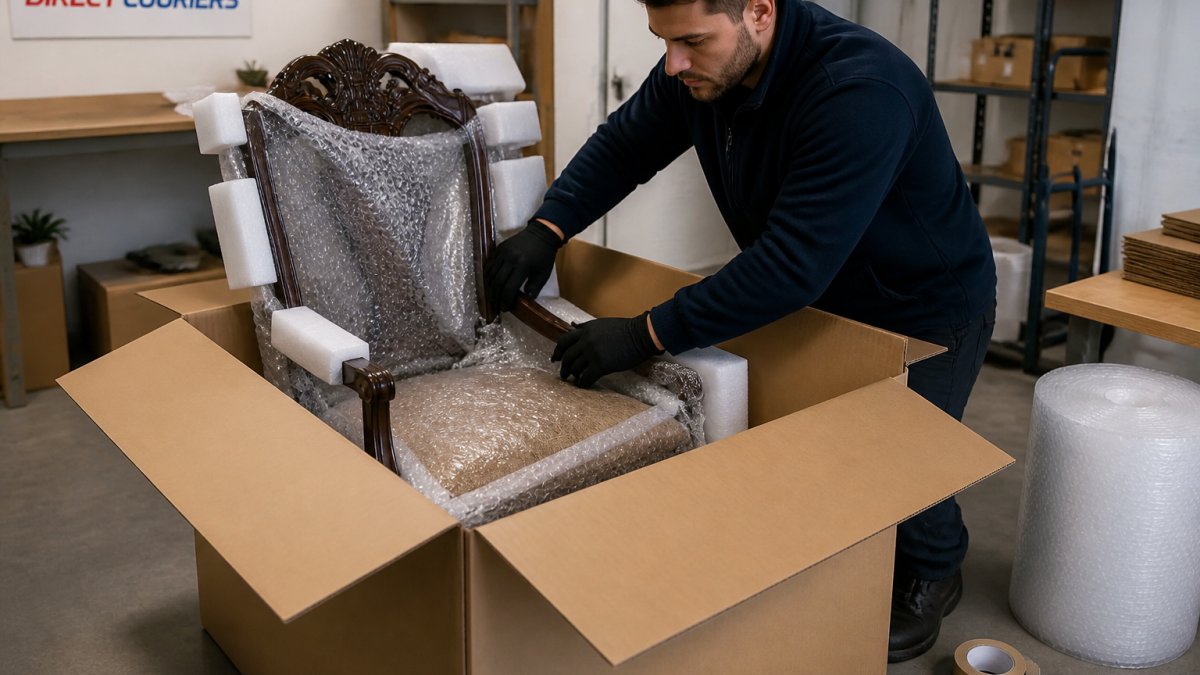
Packing is the most common reason antique claims are reduced or refused. For a step-by-step packing guide that meets insurer requirements, see How to Pack Antiques for Shipping: A Step-by-Step Guide.
Two Standards, One Claim
A courier's trading terms typically require packaging suitable for the journey and may exclude liability for inadequate packing. A specialist transit policy will usually require packing that is appropriate to the item's fragility and value, and may impose specific conditions for fragile or high-value goods. Where the two standards differ, follow the stricter one and record that you did.
What "Adequate Packing" Usually Means for Antiques
Most insurers and specialist handlers expect:
- A double-walled or rigid outer carton, or a purpose-built crate for furniture and large frames
- Internal cushioning that prevents movement in any direction, the item should not shift when the box is gently tilted
- Foam, acid-free tissue or soft wrapping against delicate surfaces, inlays, veneers and gilding
Specialist Handling and Crating
For high-value or highly fragile pieces, insurers may require a specialist art handler, a purpose-built crate, or travel in a climate-controlled vehicle. Confirm in writing whether the policy requires:
- A specialist art handling courier rather than a general parcel carrier
- A fitted crate or travel frame
- Upright transit and no transhipment
If the policy requires a specialist handler and you book a general courier, the claim can be refused even if the packing was otherwise sound.
Photograph the Packing Process
Photograph the item before packing, the internal cushioning as it is built up, the sealed outer carton from several angles, and the labels. These images are the evidence that you met the packing standard. Keep them with the valuation and the courier's terms.
Packing and the Claim
If damage occurs, the insurer will ask whether the packing met the required standard. A claim is more likely to be paid where you can show:
- The materials and method matched the insurer's written requirements
- The item was immobilised within the packaging
- Fragile parts were separated and protected
Courier Insurance Exclusions That Catch Out Antique Sellers
Exclusions are where most antique claims fail. Read the policy wording before you book, not after damage occurs.
Common courier insurance exclusions include:
- Inadequate or non-compliant packing
- Wear, tear, and pre-existing damage
- Items left unattended or unsigned for
The Financial Ombudsman Service handles disputes between policyholders and insurers when a claim is unfairly rejected, which is worth knowing if a decision feels wrong.
Making a Courier Insurance Claim: Evidence That Wins
A strong claim is built before transit, not after a loss. When making a courier insurance claim, the evidence you supply determines the outcome.
Keep a claim file containing:
- The professional valuation and condition report
- Proof of ownership and proof of value
- Pre-packing and post-packing photographs
Report damage promptly and in writing. The Association of British Insurers publishes guidance on how policyholders should handle claims and complaints. Dispute prevention comes down to documentation: the more evidence you hold, the harder a claim is to refuse.
Book a Fully Insured Antique Collection with Confidence
Moving valuable antiques should not mean gambling on vague cover. The right courier combines careful handling with insurance that actually reflects what your items are worth,
Direct Couriers London Ltd provides a fleet from compact vans to tail-lift Luton vans, with same-day and next-day services and instant tracking.
Get started with Direct Couriers London Ltd and move your antiques with tracking you can follow. Contact us today.
Frequently Asked Questions
Does standard courier insurance cover antiques?
Usually not at full value. Most standard courier insurance relies on carrier liability, which pays by weight or a fixed per-item cap rather than the antique's market value. A single-item limit of a few hundred pounds is common, so a £5,000 antique would be badly underinsured. Check the policy wording for per-item limits, total payout caps and antique exclusions before you book, and arrange specialist transit cover if the declared value exceeds the carrier's cap.
How should I value an antique for courier insurance?
Use a professional appraisal or a written valuation from a recognised auction house or antiques valuer, dated within the last 12 months where possible. Insurers distinguish market value (what it would fetch at sale) from agreed value (a figure fixed in the policy). Keep the valuation document, proof of ownership and clear photographs. Declaring a figure below replacement cost leaves you exposed to underinsurance, so declare the full amount you would need to replace the piece.
What should I do if an antique is damaged or lost during delivery?
Photograph the packaging and the damage before moving anything, keep every box and piece of wrapping, and note the damage on the delivery paperwork if you are the recipient. Report the loss to the courier and the insurer promptly, within the notification window stated in the policy. Gather your valuation, condition report, proof of value and tracking records. Do not repair or dispose of the item until the insurer has assessed it, as this can weaken a courier insurance claim.
Can I arrange separate transit insurance for a valuable antique?
Yes. Specialist transit cover can be arranged independently of the courier, either as a single-shipment policy or as annual cover for regular sellers. It typically pays on the declared or agreed value rather than by weight, and it can extend to loading and unloading, storage in transit and international shipments. Confirm the policy covers antiques, fragile items and the full route, and check whether the courier's own insurance is primary or whether your policy responds first.