 listicle
Benefits of Specialized Courier Services for E-Commerce
Table of Contents
- Why Specialized Courier Services Beat Generic Carriers for E-Commerce
- Speed, Reliability, and Reduced Failed Deliveries
- Courier Services for Small Businesses: Scaling Without the Overhead
- Specialist Delivery Services for Bulky Items and High-Value Goods
- Same-Day Courier for E-Commerce: When Speed Wins the Sale
- Courier Tracking for Online Orders: Transparency That Builds Customer Retention
- Reverse Logistics and Risk Mitigation: The Angles Most Retailers Miss
- Conclusion
- Frequently Asked Questions
Last Updated: October 14, 2026
Why Specialized Courier Services Beat Generic Carriers for E-Commerce
Specialized courier services are logistics providers built around specific cargo types, delivery windows and handling requirements, rather than a one-size-fits-all parcel network. For online sellers, the benefits of using specialized courier services for e-commerce come down to control: you know how your goods are handled, when they arrive, and what happens when something goes wrong.
Generic carriers optimise for volume. A standard parcel network moves thousands of identical boxes through automated sorting hubs, fine for small, uniform items, but it falls apart the moment your product is 2 metres long, weighs 60kg, or needs two people to lift it.
The real difference comes down to accountability. With a parcel network, a failed delivery is a ticket number. With a specialist courier, it is a phone call to someone who knows your consignment.
Speed, Reliability, and Reduced Failed Deliveries
Delivery speed and reliability decide whether an e-commerce order becomes a repeat customer or a refund request. Specialist couriers reduce failed deliveries by controlling the full journey, from collection to the doorstep, instead of handing your consignment between depots.
Failed deliveries cost more than the redelivery fee. They cost you the customer. A buyer who waits in all day for furniture that never arrives rarely orders again, and they tend to say so publicly.
Route optimization and delivery transparency
Route optimisation sequences collections and drops to cut mileage, fuel use and time per stop. It matters most for bulky goods, where a poorly planned run means a van arriving after the customer has left for work.
Transparency is the other half: when a buyer sees a live status and a realistic time window, they plan around it rather than chasing you for updates.
Courier Services for Small Businesses: Scaling Without the Overhead
Courier services for small businesses solve a specific problem: commercial-grade logistics without buying vans, hiring drivers or renting a warehouse. A specialist provider gives you capacity on demand, so fixed costs stay low while shipping volume grows.
The maths is straightforward. Paying per consignment means you only spend when you sell.
The real cost of running your own fleet
Price the alternative honestly, because the gap is wider than most sellers assume. On top of that you carry:
- Insurance, commercial vehicle cover plus goods-in-transit cover, which is priced separately and scales with the value of what you carry.
- Maintenance and compliance, servicing, tyres, MOT, and the operator licensing and driver hours rules that apply once you move beyond light vehicles.
- Driver costs, wages, holiday cover, pension contributions and the recruitment cost of replacing a driver who leaves mid-peak.
A per-consignment model converts that into a variable cost that tracks your revenue, which matters enormously in the first two years of trading when demand is unpredictable.
Managing shipping volume as you grow
Volume management is where most small sellers get caught out. Ten orders a week is comfortable; a sudden sixty is not, and that is exactly when a reliable partner matters.
- Plan for peaks, not averages. Build in headroom for seasonal spikes before they arrive.
- Book collections in batches. Grouped pickups reduce operational overhead and keep costs predictable.
- Keep packaging standardised. Consistent dimensions speed up handling and reduce damage in transit.
Integrating a courier into your tech stack
This is where small sellers either save hours a week or drown in manual admin. A specialist courier worth using should plug into the tools you already run your shop on.
- E-commerce platforms. Shopify, WooCommerce, BigCommerce and Squarespace all support third-party shipping integrations. The practical test is whether your courier can generate a label and push tracking back to the order without you copying reference numbers by hand.
- Order management and ERP. If you run stock through an ERP or order management system, ask whether the courier offers an API rather than a portal. An API lets your system create a consignment, retrieve a label and pull tracking events automatically.
- Accounting and reconciliation. Invoicing that arrives as a single consolidated statement, with consignment references that match your order numbers, saves hours at month end compared with reconciling individual receipts.
Without a developer, the minimum viable setup is a courier whose portal exports a CSV of consignments and tracking numbers for bulk upload. That single feature removes the most tedious part of scaling.
What to ask before you commit
- What happens on the day of collection if a driver calls in sick?
- Is the tracking data pushed to my platform automatically, or do I have to check a portal?
- Can you handle a tenfold spike in volume during November and December?
Specialist Delivery Services for Bulky Items and High-Value Goods
Specialist delivery services for bulky items exist because standard networks are not built for them. A specialist brings the right vehicle, lifting equipment and handling method to every job.
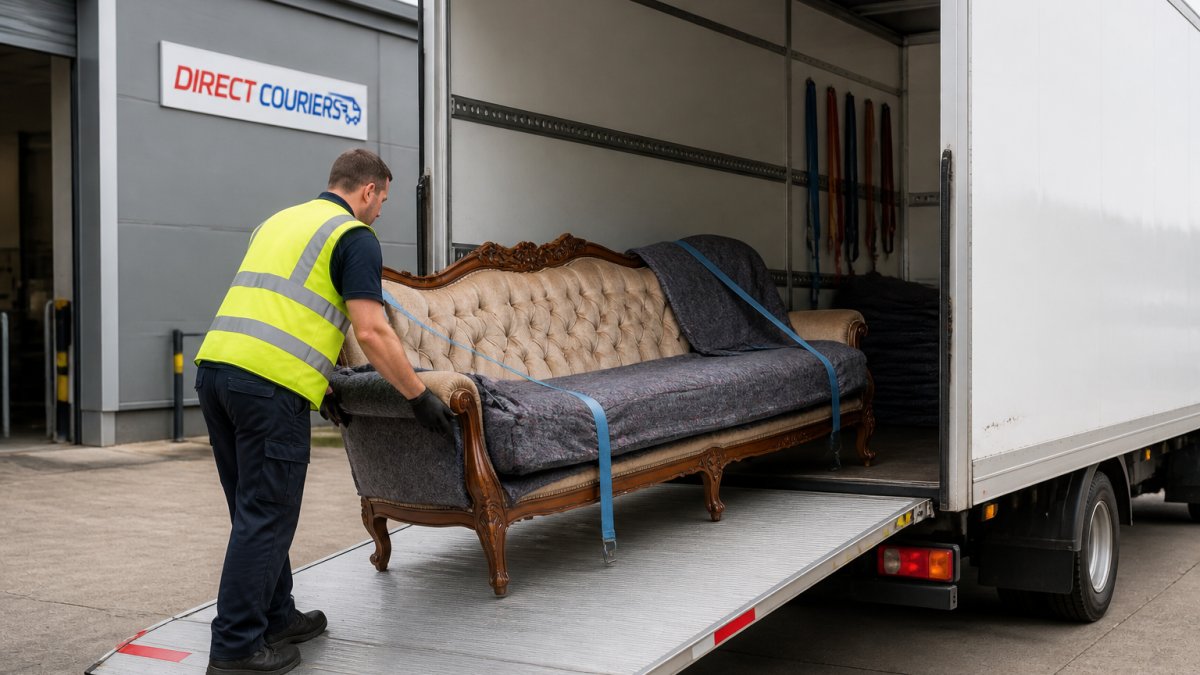
Vehicle choice does most of the work.
High-value goods need another layer of care. Protective blankets, strapping and careful loading matter more than speed when a single item is worth thousands, and insurance stops being paperwork and starts protecting your margin.
Same-Day Courier for E-Commerce: When Speed Wins the Sale
A same-day courier for e-commerce is worth the premium in one situation: when the sale depends on the delivery date. Otherwise, next-day service usually does the job for less.
Where speed does not help is when it is offered as a generic upgrade. Paying extra to shave hours off a delivery the customer did not need urgently just erodes your margin.
Courier Tracking for Online Orders: Transparency That Builds Customer Retention
Courier tracking for online orders is the cheapest retention tool in e-commerce logistics. Buyers do not mind waiting when they know where their goods are; they mind uncertainty.
A tracking link answers the question before it becomes an email. Every "where is my order?" message costs time, and enough of them cost the customer. Instant tracking turns a nervous buyer into a patient one.
Tracking is an integration problem, not a link problem
Most guides stop at "send the customer a tracking link." The harder question is how that link gets there and how the data flows back into your systems, where a specialist courier separates itself from a generic network.
- Platform-native tracking. On Shopify, WooCommerce and similar platforms, the courier's tracking number should populate the order's fulfilment record automatically, so the customer receives the standard shipping confirmation email with a working link. If you are pasting tracking numbers in by hand, you are paying a hidden labour cost on every order.
- Webhooks for real-time events. A webhook sends a tracking event to your system the moment it is scanned, collected, out for delivery, delivered, failed. That lets you trigger your own actions: a "your item is out for delivery" SMS, a review request on delivery, or an alert to your support team when a delivery fails.
- Status granularity. "In transit" tells a customer nothing. A specialist courier handling bulky or high-value goods should be able to expose more meaningful milestones, collected, loaded, en route, arrival window, delivered, because those are the events that stop a customer picking up the phone.
What good tracking data does for your operations
Tracking data is not just for customers. Patterns in delays show which routes, postcodes or product types cause trouble, so you fix problems before they repeat. A courier that gives you your own consignment history, rather than hiding it behind a support request, turns delivery from a black box into a measurable part of your business.
Practical uses for that data include:
- Identifying problem postcodes where failed deliveries cluster, so you can adjust time windows or add a call-ahead.
- Measuring your true failed-delivery rate rather than relying on a carrier's headline figure.
- Forecasting peak capacity by seeing when your volume actually spikes, not when you assumed it would.
- Feeding customer service so an agent can answer "where is my order?" in seconds rather than minutes.
The retention mechanism
There is a direct line between tracking quality and repeat purchase. A customer who gets a proactive out-for-delivery notification, a realistic time window and a delivery confirmation never needs to contact you. That frictionless experience is what they remember and compare against every other retailer.
Reverse Logistics and Risk Mitigation: The Angles Most Retailers Miss
Reverse logistics covers everything after a sale goes wrong: collections, returns, exchanges and the return leg of a delivery. Most retailers treat it as an afterthought, precisely why it damages customer relationships so badly.
The problem is structural. A returns process bolted on after the fact means the customer waits days for a collection slot, chases you for updates, and forms their final impression during the worst part of the experience.
Risk mitigation sits alongside it. As the Chartered Trading Standards Institute sets out in its guidance on consumer rights, the seller carries the risk until goods are delivered as agreed, so the courier you choose is effectively protecting your exposure.
Handling returns without damaging customer relationships
Returns handled badly undo months of good service. A few practical habits make the difference:
| Problem | Fix | Impact |
|---|---|---|
| Slow collection slots | Pre-book a returns window at point of sale | Fewer chasing emails |
| No condition record | Photograph items at collection | Cleaner dispute resolution |
| Unclear costs | State return charges upfront | Fewer checkout abandonments |
| No tracking on returns | Send a tracking link on collection | Calmer customers |
For sellers shifting bulky stock, the same fleet that delivers a sofa can collect it, which keeps the whole loop with one provider and one point of contact.
Conclusion
Returns, oversized consignments and tight delivery windows are where generic networks quietly cost you customers, and most sellers only notice after the damage is done. Direct Couriers London Ltd offers a fully insured fleet from compact vans to tail-lift Luton vans, same-day and next-day services nationwide, flexible storage for stock in transit, and instant tracking on every job. If your products are too big, too heavy or too valuable for a parcel network, contact us today for a quote.
Frequently Asked Questions
What are the benefits of using a specialist courier for e-commerce?
Specialist courier services handle bulky, fragile, or high-value items that standard parcel networks often refuse or damage. They provide same-day and next-day options, real-time tracking, and fully insured delivery. For e-commerce sellers, this means fewer failed deliveries, better customer retention, and the ability to offer delivery transparency that builds trust. Unlike generic carriers, specialists tailor routes and vehicle types to your goods, reducing package handling and operational overhead.
Are specialist courier services worth the cost for small online retailers?
For small online retailers shipping bulky or fragile items, failed deliveries, damage claims, and replacement shipping add hidden costs that erode margins. Pricing depends on quantity, dates, and delivery distance, so request a quote based on your actual shipping volume.
How does parcel tracking improve the e-commerce delivery experience?
Courier tracking for online orders gives customers real-time visibility of where their goods are, which reduces 'where is my order' enquiries and builds confidence. When a delay occurs, proactive tracking updates let you warn the customer before they complain. This transparency directly improves customer satisfaction and loyalty. For high-value or bulky items, tracking also provides a record of chain of custody, which supports insurance claims if something goes wrong in transit.
Can specialist couriers handle bulky or fragile e-commerce orders?
Yes. Specialist delivery services for bulky items use vehicles ranging from compact vans to tail-lift Luton vans, with blankets, straps, and trained handlers. They can manage furniture, antiques, palletized goods, and heavy equipment that standard couriers reject. Same-day courier for e-commerce is also available for urgent bulky orders. Fully insured delivery covers the replacement cost of high-value items, though you should confirm the cover level matches the item's value before booking.