 how-to
Fast, Secure Delivery of Large Items for Architecture Firms
Last Updated: October 23, 2026
Quick Summary
Secure delivery large items for architecture firms protects your project timeline, reputation, and bottom line by using specialist carriers with proper equipment, real-time tracking, and documented chain of custody. Planning starts weeks before shipment, coordinating with your architect, contractor, and site manager to confirm delivery windows, site access, and material handling requirements.
- Coordinate delivery logistics weeks in advance, aiming for materials to arrive within 48 hours of use on site to minimize storage costs and damage risk.
- Assess site access constraints before booking, including vehicle width and height restrictions, floor load limits, and weather conditions affecting delivery.
- Use specialist carriers experienced with architectural materials, confirming vehicle capability, insurance coverage, tracking systems, and proof-of-delivery documentation in writing.
- Document chain of custody with signed collection notes, dated photographs, and delivery signatures to support insurance claims and resolve vendor disputes.
- Refuse significantly damaged deliveries immediately and record the reason in writing with photographs to strengthen your position in damage claims.
Table of Contents
- Why Fast and Secure Delivery Matters for Architecture Firms
- Planning Delivery Logistics and Scheduling
- Assessing Site Access and Delivery Constraints
- Packing Fragile Items for Transport
- Same-Day Courier for Oversized Items
- Pallet Delivery for Businesses and Material Handling
- Heavy Item Delivery Tracking and Chain of Custody
- Choosing a Specialist Carrier and Damage Prevention
- Frequently Asked Questions
Why Fast and Secure Delivery Matters for Architecture Firms
Secure delivery large items for architecture firms protects your project timeline, reputation, and bottom line.
Building materials are heavy, fragile, and expensive, requiring specialist handling, precise scheduling, and real-time visibility. A standard parcel courier won't cut it; you need a partner who understands tight building sites, oversized materials, and the consequences of failure.
The difference between a smooth delivery and a costly problem comes down to planning, the right equipment, and a carrier who takes accountability seriously.
Planning Delivery Logistics and Scheduling
The first mistake most firms make is treating delivery logistics as an afterthought: finalize the material order, then call a courier and hope they can fit it in.
Effective planning starts weeks before materials leave the supplier.
Build a delivery calendar aligned with construction phases. Materials arriving too early consume warehouse space; too late halts progress.
If coordinating deliveries from different manufacturers, stagger them by 1-2 days to avoid loading bay bottlenecks. A tail-lift van delivering precast concrete can take 30-45 minutes to unload properly, so plan accordingly.
Assessing Site Access and Delivery Constraints
Before booking, walk your site and honestly assess what vehicles can reach the unloading point.
Check the width and height of access routes and measure doorways, hallways, and stairwells if materials go inside.
Document weight restrictions on floors or structural elements.
Weather matters too. Winter deliveries to exposed sites need extra protection and slower handling, rain makes outdoor loading bays slippery, and summer heat can affect adhesives or sealants.
Packing Fragile Items for Transport
Fragile materials demand specialist packing.
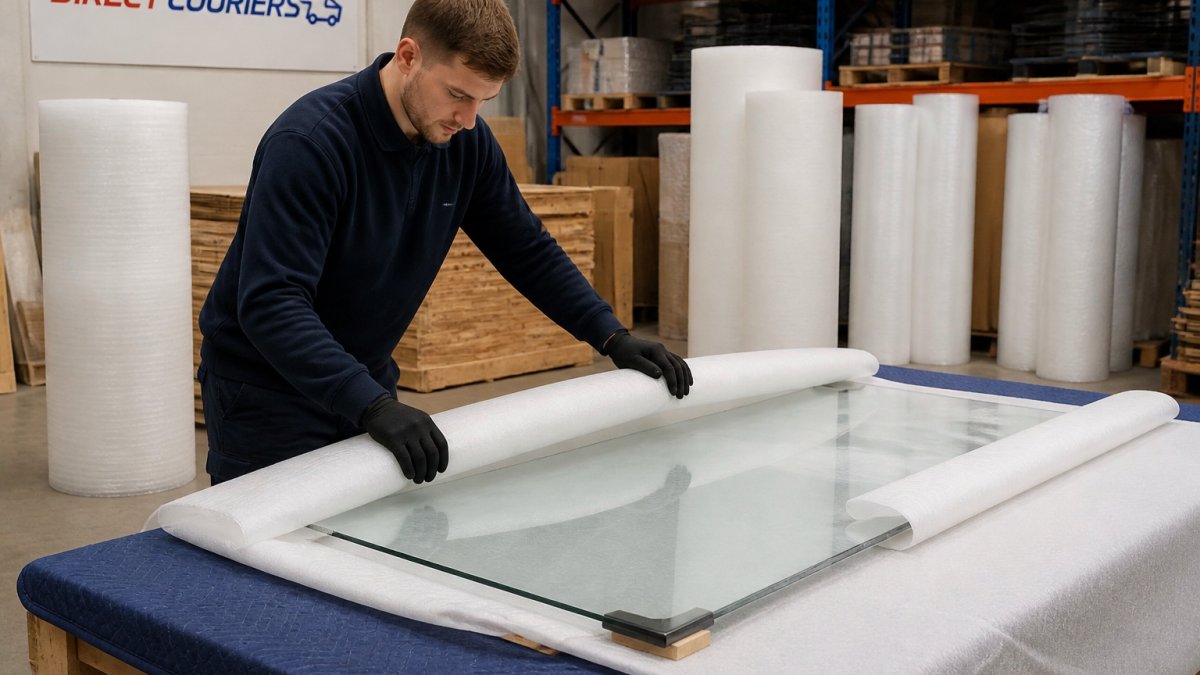
Use packaging designed for the material. Glass panels need corner protectors, edge guards, and internal spacing to prevent glass-to-glass contact.
Layer your protection: a base layer of foam or corrugated cardboard, the material, then another protective layer. Learn detailed packing techniques for heavy freight to protect fragile items during transport.
Mark packaging clearly with bright "Fragile," "This Side Up," and "Handle with Care" labels, plus your contact number and the recipient's details.
Same-Day Courier for Oversized Items
Same-day courier for oversized items works best within a 50-mile radius; anything further stretches logistics and costs significantly.
Cost varies by distance, weight, and vehicle type, so get a quote before committing.
Oversized items require drivers trained in heavy lifting and vehicle operation, expertise standard couriers often lack. A specialist carrier ensures your materials are handled safely and arrive on time.
Pallet Delivery for Businesses and Material Handling
Palletized goods enable secure delivery large items, allowing efficient loading, unloading, and handling at both ends. You can book pallet delivery for businesses through a carrier that understands material handling.
Most building materials arrive on standard wooden pallets, which are reusable and cost-effective. However, oversized or extremely heavy items may require reinforced pallets or custom crating.
Coordinate with your site team on pallet placement and storage.
Use pallet delivery for businesses through a carrier that understands material handling.
Heavy Item Delivery Tracking and Chain of Custody
Once your delivery is in transit, real-time tracking is essential for coordinating site operations and managing client expectations. But tracking is only half the picture; the other half is security and chain of custody.
What good tracking looks like
Demand instant tracking access showing vehicle location, estimated arrival time, and driver contact details, so your site manager can clear the loading bay and have the team ready. Understand how to track palletized goods delivery and maintain chain of custody throughout transport. For oversized items, ask whether tracking is live or milestone-based and whether you'll be notified automatically if the ETA changes.
Security and access control
High-value items such as architectural models, samples, bespoke joinery, and specialist equipment need more than a tracking number. Agree in advance how access will be controlled at both ends of the journey:
- Collection security. Confirm who is authorised to release the goods at the supplier and what identification the driver must present.
- In-transit security. Ask whether vehicles are locked and alarmed, whether high-value loads are tracked continuously, and whether the carrier uses sealed or tamper-evident packaging for sensitive items.
- Delivery security. Agree the named recipient and a fallback contact. For restricted sites, provide gate codes and access instructions in advance and confirm the driver will not leave goods unattended without authorisation.
Chain of custody documentation
Chain of custody documentation is equally important. Every handoff, from supplier to courier to site, should be documented with signatures and timestamps, plus photographs of material condition before and after transport. This is crucial for insurance claims and vendor disputes.
A robust chain of custody typically includes:
- A signed collection note recording the item, its condition, and the time of collection.
- Dated photographs at collection and at delivery.
- A signed delivery note naming the recipient and the time of delivery.
- Any damage notes recorded on the delivery documentation at the point of inspection.
Proof of delivery and recipient verification
Proof of delivery should be more than a scribbled signature. Ask for the recipient's name, a photograph of the item in place, and a timestamp. For high-value items, require photographic ID and a named signatory rather than "anyone on site" to close the gap between carrier and site records.
Damage reporting and refusal
Heavy item delivery tracking should include damage reporting. If materials arrive damaged, document it immediately with photos and a written description. Refuse significantly damaged deliveries and file a claim; accepting damaged goods weakens your position later.
The Last-Mile Delivery of Heavy, Bulky, Oversized Products research examined how specialist carriers manage oversized materials, emphasizing the importance of real-time communication and documented handoffs.
Choosing a Specialist Carrier and Damage Prevention
Not all couriers are created equal. Read the best courier review for palletized goods to help evaluate specialist carriers for your architectural materials. A carrier experienced with standard parcels may lack the expertise for heavy, fragile, or oversized items. The difference between a good and bad specialist carrier shows up in the details you check before you book, not after something goes wrong.
A practical carrier-selection checklist
Rather than asking vaguely whether a carrier "handles heavy items", work through a structured set of questions and record the answers. A carrier that can answer all of these clearly is usually the safer bet:
- Vehicle capability. Confirm the largest vehicle the carrier can send and whether it has a tail-lift, ramps, or a crane. Ask for the maximum load, internal dimensions, and whether the vehicle can operate within low-emission or weight-restricted zones.
- Lifting and handling services. Establish whether the carrier offers kerbside, threshold, room-of-choice, or white-glove delivery, and whether two-person crews are standard for heavy items. A single driver with a tail-lift is not the same as a two-person team that will carry a stone panel up two flights.
- Insurance and liability. Ask for the carrier's goods-in-transit cover limit, what it excludes (often glass, stone, and bespoke finishes), and whether additional cover can be arranged for high-value items. Confirm the excess and the claims window in writing.
- Delivery windows and scheduling. Check whether the carrier offers timed slots, AM/PM windows, or out-of-hours delivery, and how much notice is needed for oversized items. Same-day availability for large items is rare and should be confirmed, not assumed.
- Experience with architectural materials. Ask for examples of similar work, such as delivering glazing, precast panels, engineered timber, or finished joinery, and whether drivers are trained in load securing and material-specific handling.
- Tracking and proof of delivery. Confirm what tracking is provided, whether it is live, and what proof-of-delivery evidence is captured (signature, photograph, named recipient).
Damage prevention starts before loading
Damage prevention is a shared responsibility. Communicate clearly about what you're shipping: weight, dimensions, centre of gravity, fragility, and finished surfaces that must not be marked.
Ask about the carrier's own practices: load-securing straps and edge protection, vehicle inspections before loading, and condition records at collection. A carrier that photographs goods at collection and delivery gives you a documented baseline if a dispute arises.
Condition checks, photographic records and claims
For costly or fragile items, agree a condition-check routine at both ends. At collection, record condition with dated photographs and a short written note.
Understand the claims process before you ship: how to report damage, what evidence is required, response times, and whether claims are handled in-house or through an insurer. Keep copies of all photographs, signed documentation, and correspondence; claims often succeed or fail on paperwork quality rather than the merits of the damage.
Insurance is non-negotiable
Confirm your carrier has comprehensive cover for the full shipment value and check exclusions carefully.
The Last-Mile Delivery of Heavy, Bulky, Oversized Products research examined how specialist carriers manage oversized materials, emphasising the importance of real-time communication and documented handoffs.
BD+C's 2026 Architecture Giants survey included 200+ architecture firms reporting on their operational priorities. Reliable logistics and material delivery ranked consistently high among concerns for firms managing complex projects.
Use this checklist to evaluate whether a carrier has the capability and experience to handle your architectural materials safely.
| Selection Criteria | What to Confirm | Why It Matters |
|---|---|---|
| Vehicle capability | Maximum load, internal dimensions, tail-lift or ramps | Ensures vehicle fits your site access and material size |
| Lifting and handling | Kerbside, threshold, or white-glove delivery options | Determines whether materials reach final placement safely |
| Insurance and liability | Goods-in-transit cover limit and exclusions | Protects against loss; glass and stone often excluded |
| Delivery windows | Timed slots, AM/PM windows, same-day availability | Allows coordination with site operations and schedules |
| Architectural experience | Examples of glazing, precast, timber, or joinery delivery | Confirms drivers understand material-specific handling |
| Tracking and proof | Live tracking and photographic proof of delivery | Provides visibility and documented evidence for claims |
| Load securing practices | Straps, edge protection, vehicle inspections | Reduces damage risk during transport and handling |
Frequently Asked Questions
How should architecture firms pack large or fragile items for delivery?
Use multi-layer protective packaging: bubble wrap for delicate surfaces, foam corners for edges, and rigid cardboard boxes or wooden crates for structural protection. For architectural models and glass panels, secure items to pallets with strapping and edge protectors. Label all boxes clearly with 'Fragile' and handling instructions. Work with a courier experienced in handling oversized items, they can advise on specialist packaging for your specific materials.
What information does a courier need to deliver a large item?
Provide exact dimensions (length, width, height in centimetres), weight in kilograms, item description, delivery address with postcode, access details (lift availability, doorway width, ground-floor access), and any special handling requirements. Include contact details for both sender and recipient, and confirm whether the delivery location has a loading bay or requires ground-level unloading. This helps couriers plan the right vehicle and equipment in advance.
When should a heavy item be shipped on a pallet?
Use pallet delivery when items exceed 50 kg, require stacking with other goods, need forklift handling, or are irregular shapes that benefit from a stable base. Palletised delivery is standard for building materials such as steel beams, precast concrete, and engineered timber. It simplifies loading, unloading, and site storage, reduces damage risk, and allows multiple items to be consolidated into one shipment, improving cost efficiency for businesses.
How can I track a heavy or palletised delivery?
Request real-time tracking access when booking. Most specialist couriers provide instant tracking through a web portal or mobile app, showing vehicle location, estimated arrival time, and delivery status. For high-value items, ask about GPS tracking and photographic proof of delivery. Confirm the tracking method before shipment so you can provide accurate updates to clients or internal stakeholders.