 blog
5 Essential Tips for Reliable Nationwide Courier Service
Table of Contents
- Why Picking the Right Nationwide Courier Matters
- 1. How to Choose a Courier Service: Verify Nationwide Coverage in Practice
- 2. Match Parcel Type, Size and Weight to the Right Vehicle
- 3. Understand Courier Insurance and Liability Before You Book
- 4. Check Courier Tracking and Proof of Delivery
- 5. Compare Total Cost Beyond the Headline Quote
- Your Practical Comparison Checklist
- Conclusion: Booking a Nationwide Courier with Confidence
- Frequently Asked Questions
Last Updated: October 15, 2026
Why Picking the Right Nationwide Courier Matters
Choosing the wrong nationwide courier costs more than money. It costs customers. A missed collection or a damaged sofa can lose you a repeat buyer, and small sellers feel that loss hardest.
This guide from Direct Couriers London Ltd breaks down five essential tips for choosing a reliable nationwide courier service.
A nationwide courier is a delivery company that collects goods in one location and delivers them anywhere in the country, usually within a set time window. The right one turns a stressful move into a simple booking.
Below, we cover the five checks that matter most before you book.
1. How to Choose a Courier Service: Verify Nationwide Coverage in Practice
Coverage claims are easy to make. Real coverage is about postcodes, not marketing.
Ask any courier for their service area in writing. Then test it with a real address.
Checking Postcode-Level Coverage
A courier that covers "the whole country" may still exclude rural postcodes or charge extra for them. Send them three test postcodes: one city centre, one suburban, one remote. Ask for confirmed collection and delivery dates for each.
If the answers are vague, treat that as a warning sign.
Questions to Ask About Delivery Destinations
- Which postcodes carry a surcharge?
- Do you deliver to residential addresses, or business only?
- What is the latest booking time for next-day collection?
- Can you handle multi-drop routes across different regions?
2. Match Parcel Type, Size and Weight to the Right Vehicle
The right vehicle prevents damage. The wrong one causes it.
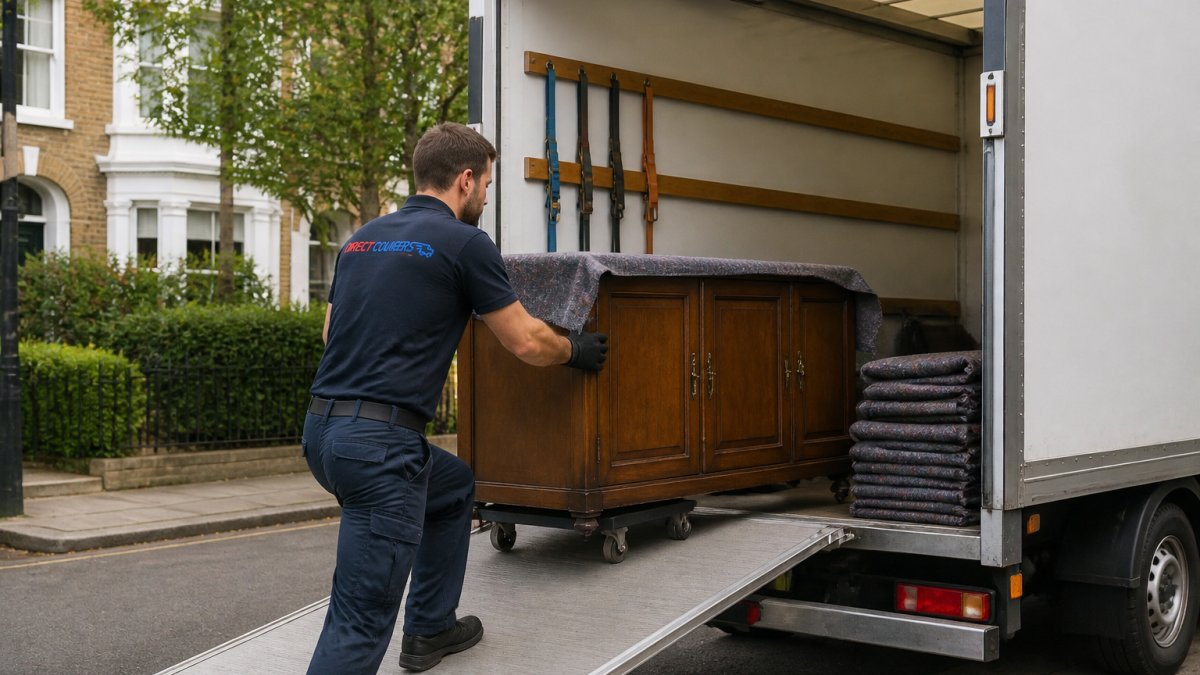
A compact van suits small, light parcels. Bulky furniture, pallets and heavy equipment need a tail-lift Luton van or a dedicated vehicle.
Special Handling for Bulky or Fragile Goods
Tell the courier exactly what you are shipping. Antiques, glass and electronics need blankets, straps and careful loading. A courier who asks about the item before quoting is usually the one who handles it well.
Dedicated Vehicles and Secure Transport
For high-value goods, ask for a dedicated vehicle. Your items travel alone, with no shared load and no extra handling. It costs more, but it removes most transit risk.
3. Understand Courier Insurance and Liability Before You Book
Insurance is where cheap quotes fall apart. Ask what is covered before you pay.
Courier insurance and liability is the cover a courier holds for goods damaged or lost in transit. Standard cover often pays by weight, not by value, which is why a £2,000 antique and a £2,000 pallet of stock can settle at wildly different figures.
Declared Value, Cover Limits and Why They Matter
Most standard goods-in-transit policies pay up to a set limit per consignment, and that limit is frequently calculated per kilogram rather than per item. If you do not declare the true value of what you are shipping, the courier's liability is usually capped at that default figure.
Ask three questions before you book:
- What is the maximum payout per consignment, and is it per item or per kilogram?
- Does the cover apply to the full declared value, or only up to a standard ceiling?
- Is there an option to increase cover for high-value items, and what does it cost?
Get the answers in writing. Verbal promises are worth nothing in a claim.
Claims, Compensation and Common Exclusions
A claim is only as strong as the evidence behind it. Most practitioners find that claims stall because the sender cannot show what was in the parcel, how it was packed, or what condition it was in at collection. Documenting the state of your shipment before it leaves your hands serves as the first line of defense in preventing package theft while ensuring that any subsequent dispute remains firmly grounded in verifiable facts.
Prepare the following before you hand anything over:
- Photographs of the item and its packaging before collection
- A description of the packaging standard used (double-walled box, corner protection, void fill)
- The declared value and any supporting invoice or valuation
- The collection and delivery addresses, plus the tracking reference
Common exclusions to check for include:
- Poor or inadequate packaging
- Fragile items sent without protective wrapping
- Prohibited or restricted goods (for example, certain batteries, liquids, or perishables)
- Delays caused by weather, strikes, or events outside the courier's control
- Consequential loss, such as lost profit from a delayed delivery
Claims Deadlines and Prohibited Goods
Claims windows are short. A common pattern is a requirement to report loss or damage within a set number of days from the delivery date, with supporting evidence submitted shortly after. Miss the window and the claim can be refused regardless of fault.
Ask the courier to confirm, in writing:
- The deadline for reporting loss or damage
- The deadline for submitting evidence
- The expected settlement timeframe
- Which goods they will not carry at all
How to Compare Protection Between Couriers
Do not compare headline cover figures alone. Compare the declared-value ceiling, the per-kilogram default, the exclusions list, the claims deadline, and the evidence required. A courier with a lower headline limit but a clear, fast claims process can be the safer choice for regular business shipments.
Goods vehicle and goods-in-transit insurance guidance
4. Check Courier Tracking and Proof of Delivery
Tracking protects your reputation. When a customer asks where their order is, you need an answer in seconds.
Courier tracking is the system that shows where your goods are at each stage of the journey.
Real-Time Tracking and Delivery Notifications
Good tracking shows collection, transit and delivery in real time. Delivery notifications tell you and your customer when the parcel arrives. Ask if tracking is instant or updated once a day.
Service-Level Agreements and Measurable Reliability
A service-level agreement sets out what the courier promises and what happens if they miss it. Ask for:
- On-time delivery targets
- The process for missed collections
- Compensation terms for delays
A courier who will not put reliability in writing is asking you to take all the risk.
5. Compare Total Cost Beyond the Headline Quote
The cheapest quote is rarely the cheapest job. Surcharges decide the final bill, and they are usually invisible until the invoice arrives.
Why the Headline Quote Is Not the Price
A headline quote typically covers the base transport charge for a standard parcel between two standard postcodes. Everything outside that definition is an add-on. Two couriers can quote the same headline figure and bill you very differently once the job is real.
The Surcharges That Change the Final Bill
Watch for these extras, and ask how each is calculated:
- Fuel surcharge, often expressed as a percentage of the base rate and adjusted periodically, so it can change between quote and invoice
- Remote-area surcharge, applied to certain postcodes, frequently in the Highlands, islands, and rural areas, and sometimes charged per consignment rather than per parcel
- Waiting time, charged per hour or part-hour when loading or unloading exceeds the agreed free period
- Redelivery, charged when nobody is available to receive the goods and a second attempt is needed
- Oversized or overweight items, charged when a parcel exceeds the standard dimensions or weight band, often per additional kilogram or per extra metre
- Out-of-hours or weekend collection, charged when the collection falls outside standard working hours
- Cancellation, charged when a booking is cancelled after a cut-off point, sometimes as a percentage of the job value
Ask for an all-in quote, in writing, before you book. The quote should state the base rate, each applicable surcharge, and the conditions that trigger them.
How to Build a True Cost Comparison
Compare couriers on the same job, not on the same headline figure. For each quote, record:
- The base rate
- The fuel surcharge percentage and how often it is reviewed
- Whether your delivery postcode attracts a remote-area fee
- The free waiting period and the hourly rate after that
- The redelivery charge
- The oversized-item threshold and rate
- The cancellation terms
Add these together for your specific shipment. The courier with the lowest headline quote is often not the one with the lowest all-in price.
When a Same-Day Courier Service Is Worth It
A same-day courier service costs more, but it earns its fee when a client deadline is at stake. For urgent parts, legal documents, or a customer waiting on a sofa, same-day delivery protects the relationship. For routine stock, next-day is usually enough.
Your Practical Comparison Checklist
Use this scoring table when you compare couriers. Score each one from 1 to 5.
| What to Check | What Good Looks Like | Why It Matters |
|---|---|---|
| Coverage | Confirmed for your postcodes | Prevents refused or delayed jobs |
| Vehicle fit | Tail-lift or dedicated option | Cuts damage risk on bulky goods |
| Insurance | Written cover limits | Protects high-value items |
| Tracking | Real-time plus delivery notification | Keeps customers informed |
| Total cost | All-in quote, no surprise fees | Avoids a bigger final bill |
Conclusion: Booking a Nationwide Courier with Confidence
Five checks separate a smooth delivery from a stressful one: real coverage, the right vehicle, honest insurance, working tracking and a true total cost.
At Direct Couriers London Ltd, our fleet runs from compact vans to tail-lift Luton vans, every delivery is fully insured, and tracking is available instantly. We also offer flexible storage for stock or belongings while you move or renovate.
Contact us today for a quote and book a nationwide courier you can rely on.
Frequently Asked Questions
How can I tell whether a courier service is reliable?
Look beyond the website. Ask for a service-level agreement that states on-time delivery targets, check whether tracking updates are automatic or manual, and confirm what happens if a collection is missed. A reliable nationwide courier will give you named contacts, a clear complaints process and proof of delivery for every shipment. Also ask how they handle delays and whether compensation is automatic or requires a claim.
What insurance should a courier service provide?
At minimum, a courier should hold goods-in-transit cover that protects your parcel against loss or damage. Ask for the cover level per consignment, whether it covers the full replacement value of high-value items like antiques, and what exclusions apply. Standard liability is often limited, so for expensive goods you may need to declare the value and pay a supplement. Always get the insurance terms in writing before booking.
Is a same-day or next-day courier service right for my delivery?
Same-day suits urgent, high-value or time-critical shipments where a dedicated vehicle collects and delivers directly without going through a depot. Next-day is more cost-effective for less urgent parcels and often uses a network. If your customer expects furniture by a certain date, same-day removes sorting delays. For regular business deliveries, a mix of both can balance speed and cost.
How can I track a courier delivery?
Reputable couriers provide a tracking number or link that shows collection, in-transit scans and delivery confirmation. Real-time GPS tracking is common for same-day dedicated vehicles, while network services update at depot milestones. Ask whether you and your customer receive automatic delivery notifications, and whether a photo or signature is captured as proof of delivery. If tracking is only available on request, that is a warning sign.